Updated March 2nd, 2023 by Ben Reynolds
The Chowder Rule is an heuristic method to find high total return stocks for your dividend growth portfolio.
A brief definition of The Chowder Rule is below:
The Chowder Rule is a rule-based system used to identify dividend growth stocks with strong total return potential by combining dividend yield and dividend growth.
The Chowder Rule was invented and popularized by Seeking Alpha contributor Chowder. The rule gets its name from the Seeking Alpha contributor (not from soup).
The Chowder Number is derived from applying The Chowder Rule. The Chowder Number is calculated as a stock’s current dividend yield plus it’s 5-year dividend growth rate.
The Chowder Rule is applied differently to different stocks. The criteria and rules are below:
Rule 1: If stock has a dividend yield greater than 3%, its Chowder Number must be greater than 12%.
Rule 2: If a stock has a dividend yield less than 3%, its Chowder Number must be greater than 15%.
Rule 3: If a stock is a utility, its 5-year dividend growth rate plus its dividend yield must be greater than 8%.
This means that what passes as a ‘good’ Chowder Number score depends on a stock’s current dividend yield (if it’s over or under 3%) and the sector it’s in (if it’s a utility or not).
This article examines the methodology of the Chowder Rule. The article also lists all stocks with 25+ years of rising dividends that pass the Chowder Rule.
Table Of Contents
Rules Based On Intelligent Investing Concepts
The Chowder Rule combines 2 intelligent investing concepts:
Expected total return investing is a strategy where investors look for businesses with the highest expected compound annual growth rate. The expected compound annual growth rate is approximated as dividend yield plus expected growth on a per share basis plus annualized valuation multiple changes. In other words, total return investing takes into account the only 3 sources of stock market returns:
- Dividends
- Growth on a per share basis
- Valuation multiple increases
The ‘Margin of Safety’ concept was popularized by Warren Buffett’s mentor (and value investing pioneer) Benjamin Graham.
Benjamin Graham required a margin of safety in his investments. If he thought the fair value of a stock was $100, he was not willing to pay $100 for it. Graham typically required a 33% margin of safety. In the $100 example, Graham would only pay ~$67 for the stock.
Combining the margin of safety principle with the stocks of businesses trading below liquidation value allowed Graham to compound his wealth at around 20% a year for decades.
The Goal of The Chowder Rule
The goal of the Chowder Rule is to create a long-term compound annual growth rate of over 8%.
The Chowder Rule applies both ‘Margin of Safety’ and ‘Total Return’ thinking to accomplish this goal.
For stocks with a dividend yield over 3%, a 33% ‘margin of safety’ is used. Instead of hoping everything goes smoothly with a stock with a projected CAGR of 8%, invest in stocks with a projected CAGR of 12% and give yourself a 33% margin of safety.
The margin of safety is expanded for fast-growing low-yield dividend stocks. If a stock has a dividend yield below 3%, the required projected CAGR is expanded from 12% to 15%. This gives you a 47% margin of safety. The intuition behind this is that fast-growing stocks will likely have their growth slow at some future point, so a higher margin of safety is required.
Utility stocks typically have high yields and slow growth rates. They are highly regulated and typically enjoy regional competitive advantages from strong barriers to entry. As a result, the margin of safety on utility stocks is removed using the Chowder Rule. Utility stocks need only have an expected total return of 8% to pass the Chowder Rule
Note that Seeking Alpha author Chowder recommends using the Chowder Rule last.
Before applying the Chowder Rule you should find high quality businesses with excellent managements worthy of long-term holding.
The Chowder Rule comes into play only after you have identified a business you’d like to buy and hold. The Chowder Rule is the final step in determining whether or not the business is priced to buy.
Improving The Chowder Rule
The Chowder Rule makes intuitive sense.
The only issue that we have with the Chowder Rule is how unreliable using the 5 year dividend growth rate is for projecting growth.
The dividend growth rate is subject to changes in the payout ratio. Take the following example:
- A Stock’s earnings-per-share fall from $10.00 to $5.00 in 5 years
- The stock raises its dividend from $1.00 per share to $3.00 per share in 5 years
Does the stock really have a fantastic 20%+ growth rate? No; the underlying business is likely in decline. The dividend growth rate shows tremendous growth, but this growth is not sustainable. This is because the payout ratio has increased from 10% to 60% in 5 years. That is where the illusory growth comes from.
Earnings-per-share growth is typically preferable to dividend growth as an indicator of underlying business growth on a per share basis.
Earnings-per-share numbers are far from foolproof. They are reliant on profit margins. Profit margins are typically mean reverting over long periods of time and can unfairly skew (either up or down) a company’s real underlying business growth.
We prefer to use a reasonable estimate of future growth that is based on historical earnings-per-share growth, management’s expectations of growth going forward, and our own analysis of future growth potential.
Estimating future growth does put human bias into the investment decision. It also eliminates errors from accounting irregularities or one time earnings (or dividend) spikes or declines. The goal in estimating future growth is to be reasonable and cautious, not to be rigid.
Stocks With 25+ Years Of Dividend Growth & The Chowder Rule
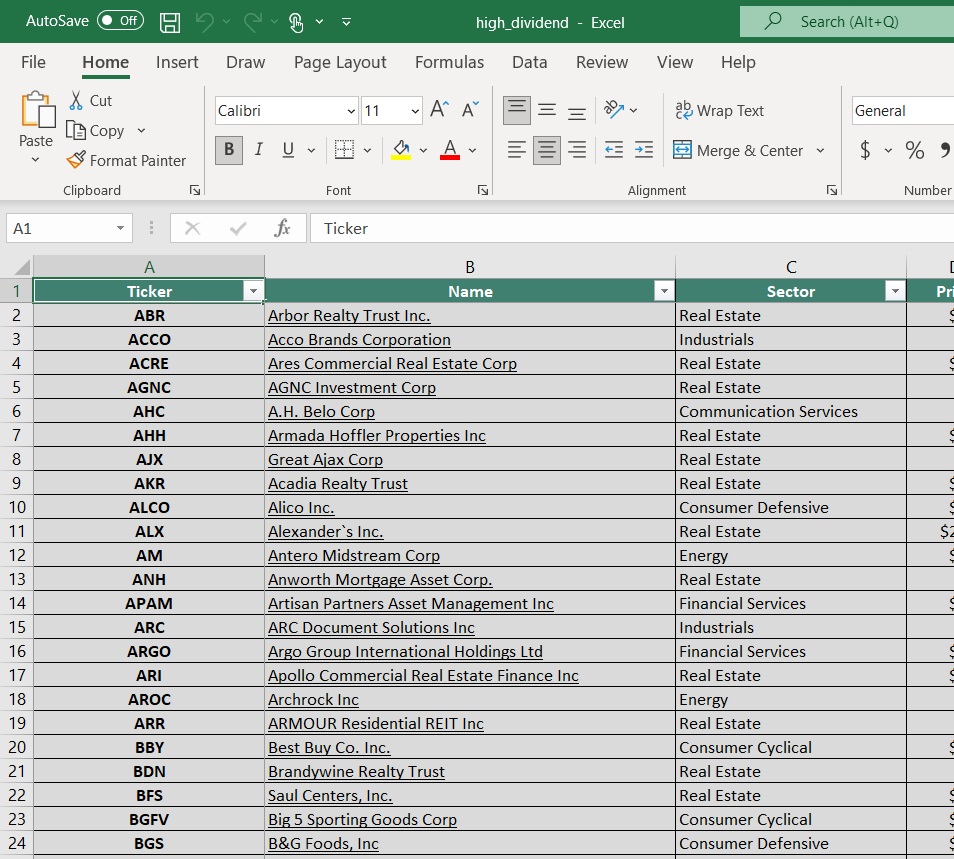
There are currently more than 150 securities in The Sure Analysis Research Database with 25+ years of consecutive dividend increases. You can download a spreadsheet of ‘Dividend Champions‘ – securities with 25+ years of rising dividends – at the link below.
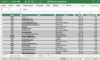
Having been able to increase dividends for 25+ years is a good rule-of-thumb to identify high quality businesses with shareholder friendly managements. From there, we calculate The Chowder Number for all of these securities to find which ones pass The Chowder Rule.
We use our 5-year forward growth on a per share basis estimate as a proxy for The Chowder Rule’s 5-year dividend growth rate in our calculations. The securities that pass The Chowder Rule are sorted by Chowder Number (from highest to lowest) and broken down by category below.
Interestingly, only 18 securities with 25+ years of Rising Dividends pass The Chowder Rule tests. This shows how exclusive these rules are in today’s low yield environment.
Each security that passes The Chowder Rule has a link to the most recent Sure Analysis Research Database report on the company.
3%+ Yielding Securities
Chowder Rule #1: Chowder Score of 12%+
Clorox (CLX)
Dividend Yield: 3.1%
Growth Estimate: 12.0%
Chowder Number: 15.1%
Note: Clorox technically passes the Chowder Rule based on our earnings-per-share growth estimate, but this estimate is off of a low base (we expect earnings-per-share of $4.20 in fiscal 2023) as the company is struggling with elevated commodity and logistics costs. Going off of the company’s 2021 earnings-per-share of $7.25 would show a tepid growth rate of under 1%, meaning Clorox would not pass the Chowder rule. As of now Clorox passes the mechanical Chowder Rule, but doesn’t pass the intent of the Chowder Rule. This highlights the inherent limitations of using a formulaic approach to investing, and why interpretation and intent are important to consider.
Stanley Black & Decker (SWK)
Dividend Yield: 3.8%
Growth Estimate: 10.0%
Chowder Number: 13.8%
Note: We have a similar situation with Stanley Black & Decker as we do with Clorox. The company’s earnings have collapsed due to COVID-related supply chain and demand issues, but we expect a swift rebound in earnings in the years to come. It otherwise would not meet the revised Chowder Rule.
Securities With Yields Under 3%
Chowder Rule #2: Chowder Score of 15%+
Ecolab Inc. (ECL)
Dividend Yield: 1.3%
Growth Estimate: 15.0%
Chowder Number: 16.3%
Target Corporation (TGT)
Dividend Yield: 2.7%
Growth Estimate: 20.0%
Chowder Number: 22.7%
Note: Target has the same qualifier as Clorox and Stanley Black & Decker, where earnings are well down (temporarily, we believe), and is therefore seeing a higher-than-normal Chowder value.
Utilities
Chowder Rule #3: Chowder Score of 8%+
UGI Corp. (UGI)
Dividend Yield: 3.9%
Growth Estimate: 5.5%
Chowder Number: 9.4%
Essential Utilities (WTRG)
Dividend Yield: 2.7%
Growth Estimate: 8.0%
Chowder Number: 10.7%
SJW Group (SJW)
Dividend Yield: 2.0%
Growth Estimate: 8.0%
Chowder Number: 10.0%
Fortis (FTS)
Dividend Yield: 4.3%
Growth Estimate: 6.0%
Chowder Number: 10.3%
American States Water (AWR)
Dividend Yield: 1.8%
Growth Estimate: 7.1%
Chowder Number: 8.9%
NextEra Energy (NEE)
Dividend Yield: 2.7%
Growth Estimate: 7.0%
Chowder Number: 9.7%
New Jersey Resources (NJR)
Dividend Yield: 3.1%
Growth Estimate: 5.5%
Chowder Number: 8.6%
Entergy (ETR)
Dividend Yield: 4.2%
Growth Estimate: 5.0%
Chowder Number: 9.2%
Canadian Utilities (CDUAF)
Dividend Yield: 4.0%
Growth Estimate: 5.0%
Chowder Number: 9.0%
Atmos Energy (ATO)
Dividend Yield: 2.7%
Growth Estimate: 6.0%
Chowder Number: 8.7%
Artesian Resources (ARTNA)
Dividend Yield: 2.0%
Growth Estimate: 6.4%
Chowder Number: 8.4%
Eversource Energy (ES)
Dividend Yield: 3.7%
Growth Estimate: 6.0%
Chowder Number: 9.7%
Northwest Natural Holding Company (NWN)
Dividend Yield: 4.1%
Growth Estimate: 4.1%
Chowder Number: 8.2%
Black Hills Corporation (BKH)
Dividend Yield: 4.1%
Growth Estimate: 4.0%
Chowder Number: 8.1%
Final Thoughts & Further Reading
Two stocks pass the first version of the Chowder Rule, which demands a 3% yield or better. Two stocks pass the second version, which is for those below a 3% yield. However, of the four, they’re all dealing with some version of depressed earnings this year, which boosts their projected growth rates. We reiterate that while these may pass the technicality of the Chowder Rule, they don’t pass muster when it comes to the spirit of the rule, as these high growth rates aren’t sustainable.
On the other hand, we have 14 utilities that meet the rule, which gives investors plenty of choice when it comes to selecting a great dividend stock to buy based on the Chowder Rule.
The Chowder Rule is a useful tool to find compelling dividend growth stock ideas. Its rules are a relatively high bar to pass, as evidenced by how few securities made the cut in our analysis in this article.
With that said, the following lists contain other potentially high quality dividend growth stocks to consider:
Thanks for reading this article. Please send any feedback, corrections, or questions to [email protected].