
Edmund Burke once said, “It is the nature of all greatness not to be exact.” There is a certain kind of conversation I often have that brings this point to mind. I often argue that we underestimate the degree to which bottom-up, evolved orders can solve the kinds of public goods or externality problems that some insist can only be solved through top-down coercion. Occasionally, an interlocuter will follow up with what they imagine is a killer question—“Do you have a specific mechanism in mind people will use to solve this particular problem?” But asking this question only shows one has misunderstood the argument.
Innovation occurs when someone comes up with an idea that nobody has thought of before. By their very nature, innovative ideas can’t be identified in advance. If we already knew what they were, they wouldn’t be innovative ideas, they would be established ideas. Similarly, freedom isn’t simply the liberty to stick to established ideas—freedom means giving people the room to deal with the troubles of life in ways that are new and innovative, ways that haven’t been tried before or specified in advance. In advance, I could not have identified the specific mechanisms people would have used to solve common pool resource problems of the kind Elinor Ostrom made a career out of identifying. Nor could I, in advance, have specified the “custom of the orchard” that emerged among beekeepers to handle the externalities associated with beekeeping. I’ve criticized this sort of thinking with the terribly clunky term “the 5-1 error” before—the inability to see solutions to collective action problems that evolve organically because one can only conceive of them as functioning by known mechanisms specified in advance.
There is a certain breed of intellectual who holds their intellect in such high esteem that they fail to grasp how little their own mind can contain about the world around them. Thus, if they cannot see or identify a way for people to solve a problem among themselves, that’s as good as saying no such solution exists. Alternatively, intellectuals of this sort can go a step further, and offer a positive argument for why bottom-up solutions cannot work, thus requiring top-down coercive solutions to be created and imposed by…well, intellectuals such as themselves.
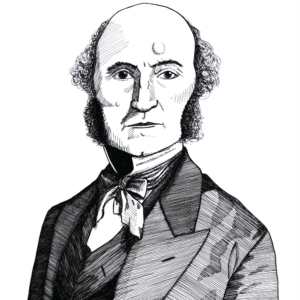
In terms of raw brainpower, few people in history could claim to be at the level of John Stuart Mill. Yet Mill had many curious blind spots. He was very concerned with issues of distribution over production, because he believed the potential for productive growth had basically peaked—so all further improvements in the standard of living would have to come about through ever more efficient and clever distribution instead of increased production. He worried that we would soon run out of music to create, because the range of musical notes we can hear is finite and the number of possible note combinations is also finite. From his armchair, he produced an argument for why lighthouses, as public goods, could not be provided on the private market and thus required public provision.
But Mill was wrong about all of these things. It should be obvious to the reader how Mill failed to predict how our capacity for production would continue to grow, and that musical innovation has only grown as well. But these are only failures of prediction on Mill’s part. His conclusion about lighthouses was not merely a failure of prediction, it was a failure of observation as well. Even as Mill made that argument, as Michael Munger points out, “most—more than three-quarters—of all lighthouses had been built, and were being operated, by private individuals.” Had Mill gotten out of his armchair and gone out to a port to check, he could have seen that his argument was mistaken, and people found private solutions to the public goods problem. But he saw no need to check—he had his argument showing private actors couldn’t solve the public goods problem and state action was needed. He saw no mechanism that he could specify in advance to solve this problem—which was as good as proving no such mechanism existed. J. E. Meade, too, had his argument for why beekeepers could not solve the externality problems related to beekeeping, and he felt no need to bother to actually check to see if he was right. He couldn’t think of a way to specify a solution, so no solution existed as far as he was concerned. He was wrong too.
If people were only granted freedom when its benefits can be identified and specified in advance, freedom and innovation would utterly cease. Too many intellectuals see themselves as fit to set the boundaries on other peoples’ freedoms based on nothing more than the limits of their own understanding. As is often the case, Thomas Sowell said it better than anyone else:
Freedom is not simply the right of intellectuals to circulate their merchandise. It is, above all, the right of ordinary people to find elbow room for themselves and a refuge from the rampaging presumptions of their “betters.”