
CHIPATA, ZAMBIA, Nov 01 (IPS) – As we approach the forest in the village to appreciate Andrew Mbewe’s beekeeping enterprise, a bee from a hive close to the edge of the natural woodland stings him on the cheek.
He steps back quickly, waving everyone away from danger, as he grimaces and grumbles in pain while trying to take out the stinger to prevent his face from swelling.
“That’s one of the duties they are performing,” he says through his gritted teeth about his 18 beehives in this forest.
He examines the tips of his index and thumb fingernails to see if he has taken out the bee’s poison-injecting barb.
“These bees are guardians of this forest,” he says. “They protect it from invaders. That’s one of the reasons this forest is still standing today.”
Across the villages along the Chipata-Lundazi road, which cuts through a landscape that stretches between Kasungu National Park in Malawi and Lukusuzi and Luambe National Parks in Zambia’s Eastern Province, one feature is likely to catch the eye: impressive stands of natural forests among villages and smallholder farms.
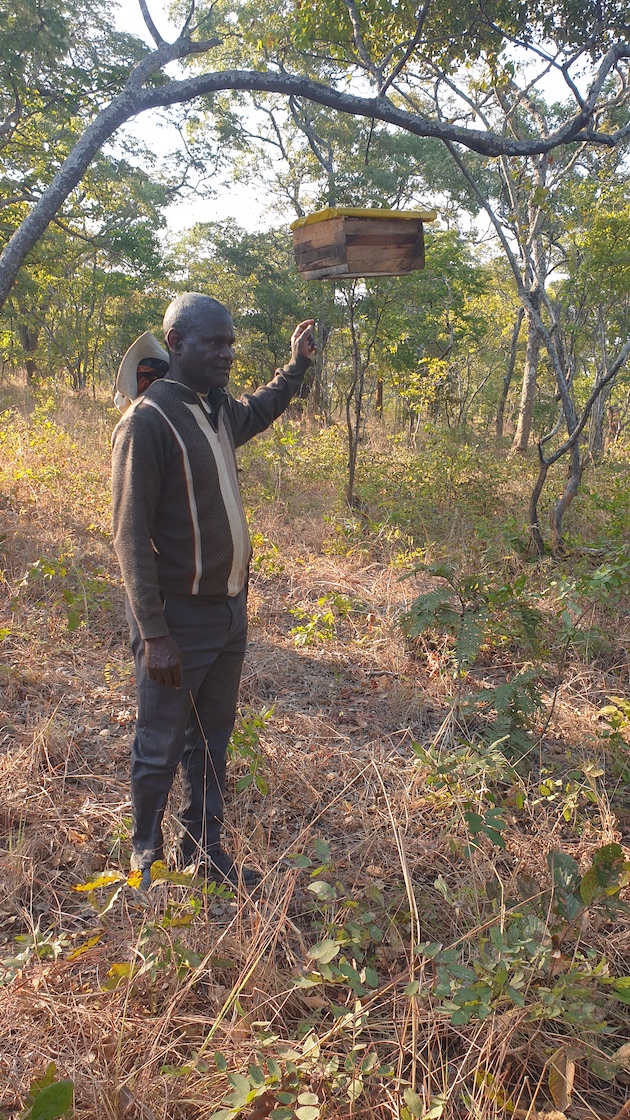
In Mbewe’s village in Chikomeni chiefdom in Lundazi district, these indigenous forests are home to over 700 beehives belonging to more than 140 families.
The forest protection duty that the bees are providing is an unintended consequence of the beekeeping enterprise. Fundamentally, the communities are sucking money out of the honeycombs in these beehives through sales of both raw and processed honey, some of which find space on the shelves of Zambia’s supermarkets.
It is one of the livelihood activities which Community Markets for Conservation (Comaco), in partnership with the International Fund for Animal Welfare (IFAW), are implementing within the broader wildlife conservation strategy in the Malawi-Zambia landscape.
Comaco’s driving force is that conservation can work when rural communities overcome the challenges of hunger and poverty.
It says these problems are often related to farming practices that degrade soils and drive deforestation and biodiversity loss.
Therefore, Comaco works with small-scale farmers to adopt climate-smart agriculture approaches such as making and using organic fertilisers and agroecology to revitalise soils so farmers achieve maximum crop productivity.
It also supports small farmers to add value to their produce and attractively brand the products so they are competitive in the market.
With burgeoning carbon trading as another revenue stream, this wildlife economy is raking in promising sums for both individual members and their groups, communities say.
The cooperative to which Mbewe belongs has used part of its revenue to purchase two vehicles – 5-tonne and 3-tonne trucks – which the group hires out for income. The money is invested in community projects such as building teachers’ houses and hospital shelters.
Luke Japhet Lungu, assistant project manager for the IFAW-Comaco Partnership Project, tells IPS that these activities are making people less and less reliant on exploiting natural resources for a living.
“You will not find a bag of charcoal here,” Lungu challenges.
“Because of the farming practices we adopted, people are realising that if they destroy the forest, they also destroy the productivity of their land and their income will suffer,” he says.
Along the way, people are also learning to live with the animals.
“Animals are able to move from one forest to another without disturbance. For the bigger ones, such as elephants, which would cause damage to our crops, we have a rapid communication system through our community scouts who work with government rangers.
“We have occasions of elephant invasions from the three parks. However, we have learnt to handle them better to minimise conflict. It’s a process,” Lungu says.
One man who has learnt to manage the animals he once hunted is Mbewe himself.
A battle-scared poacher for nearly a decade from the 1980s, he terrorised the 5,000-square-kilometre conservation area on poaching missions.
For his operations, he used rifles he rented from some officials within the government of Zambia, he claims.
“They were also my major market for ivory and other wildlife products,” he says.
Apparently, without knowing it, Mbewe was actually supplying a far bigger transnational market.
For over 30 years, from the late 1970s, the Malawi-Zambia conservation area was a major source and transit route for ivory to markets in China and Southeast Asia.
Elephant poaching rocked the landscape resulting in the decline of the species. In Kasungu National Park, for example, according to data from the Department of National Parks and Wildlife in Malawi, elephant numbers dwindled from 1,200 in the 1970s to just 50 in 2015.
In 2017, IFAW launched a five-year Combating Wildlife Crime project whose aim was to see elephant populations stabilise and increase in the landscape through reduced poaching.
The project supported park management operations and constructed or rehabilitated requisite structures such as vehicle workshops and offices.
It trained game rangers and judiciary officers in wildlife crime investigation and prosecution.
It provided game rangers with uniforms, decent housing, field allowances, patrol vehicles and equipment.
It supported community livelihood activities such as beekeeping and climate-friendly farming.
It also thrust communities to the centre of planning wildlife conservation measures.
Erastus Kancheya is the Area Warden for the Department of National Parks and Wildlife for the East Luangwa Area Management unit where Lukusuzi and Luambe National Parks lie.
He says he sees these measures as enabling degraded protected areas like Lukusuzi National Park to “rise from the long-forgotten dust awakening on the long road of meaningful conservation”.
Kancheya says engaging communities in co-management of the protected areas is also proving to be effective in the landscape.
Now, IFAW is leveraging this community partnership to sustain the achievements of the Combating Wildlife Crime project through its flagship Room to Roam initiative.
Patricio Ndadzela, Director for IFAW in Malawi and Zambia, describes Room to Roam as a broad, people-centred conservation strategy.
“This is an initiative that cuts across land use and planning, promotes climate-smart approaches to farming and ensures people and animals co-exist,” he says.
The approach aims to deliver benefits for climate, nature and people through biodiversity protection and restoration.
Room to Roam intends to build landscapes in which both animals and people can thrive.
In the process, some people are being transformed. Mbewe is one such person. From being a notorious poacher, he is now a ploughshare of conservation as chairperson of the Community Forest Management Group in his area. The cooperative enforces wildlife conservation and sustainable land management practices.
It is not easy work, he admits.
“There are hardened attitudes to change, and patience is required to teach. Sometimes, the earnings from the livelihood activities are insufficient or irregular. For instance, you don’t harvest honey every day or every month,” he says.
Yet, he says, the prospects are good and the challenges he faces now rank nowhere near what he encountered when he was a poacher.
One incident still makes him shudder: Stalking a herd of elephants at their drinking spot in Kasungu National Park one day, he came under unexpected gunfire from rangers.
“I was an experienced poacher. I knew at what time of the day to find the elephants and at what location. But the rangers saw me first. I was dead. I don’t understand how I escaped,” he says.
Today, on reflection, he regrets having ever lived the life of a poacher.
“I went into poaching for selfish reasons,” Mbewe says thoughtfully.
“Poaching was benefiting me only; the conservation work I am doing now is benefiting the entire community and future generations,” he tells IPS while rubbing the spot of the bee sting and looking relieved.
IPS UN Bureau Report
Follow @IPSNewsUNBureau
Follow IPS News UN Bureau on Instagram
© Inter Press Service (2023) — All Rights ReservedOriginal source: Inter Press Service