On July 8, 56.7 million rural voters across West Bengal will go to the polls. The rural body polls were announced last week. Almost on cue, clashes broke out, killing at least eight people till now.
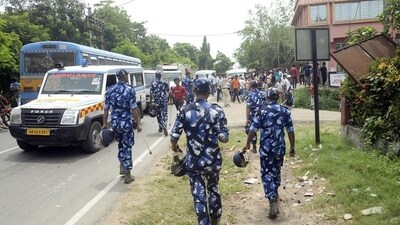
Before we analyse the violence, it is useful to clear up a few misconceptions. First, while the Trinamool Congress (TMC) is the dominant party in West Bengal, it is not the only party meting out violence. It is hard to count who is directly killed in political violence, but at least four of those dead are TMC workers. Second, although we await final numbers, this panchayat election is seeing more robust contests as compared to five years ago, when the TMC won 34% of the gram panchayat seats uncontested. In fact, the TMC may have waited until the last minute to file many nominations to prevent aggrieved aspirants from contesting as independent candidates — suggesting some amount of friction within the party ranks.
As the above caveats suggest, violence in Bengal’s panchayat elections is not a simple story of a dominant party perpetrating violence against all others. Rather, it is a combination of internal factional fights, and a culture of violence that all parties participate in during election time. What can be the reason?
Explaining the causes behind the violence is not to justify it; rather, a deeper comprehension of its roots can help us understand the politics of West Bengal. The state has been known for strong panchayats well before the passage of the 73rd and 74th amendments to the Constitution that formally ushered in local governance across India. This was a result of the “party society” which began under Left rule in the state, as described by professor Dwaipayan Bhattacharya; panchayats were responsible for certain kinds of policy implementation, as well as social and political mobilisation. This implied that large-scale social mobilisation and policy implementation were dependent on near-universal control of panchayats.
Today, the policy role of panchayats has changed significantly as chief minister Mamata Banerjee has built a direct connection to voters through more centralised cash transfers and grievance redressal systems. But the logic of social control, and by extension, the capacity of local panchayats to take care of their citizens, is still largely intact. A powerful panchayat is one that controls access to all levers of the State, and cannot entertain any alternative route for citizens. Unfortunately, a byproduct of this need to demonstrate social control is also a display of the capacity for violence.
One can see why this logic is important for electoral outcomes in the state. If a panchayat is able to demonstrate social control, a citizen will be wary of voting for another party — which would sever the tie between the panchayat and the State. In this manner, it is well-understood that to control panchayats is to control future electoral outcomes. It does not follow, however, that the ruling party can always control the panchayats. In fact, the Left first lost the panchayats in the wake of trouble in Singur and Nandigram, a precursor to being decimated in state and national elections. In this manner, the panchayat vote is also a test of the organisational capacity of each party.
Let me make the implications of this social control model more clear. One of the red herrings in the analysis of the 2019 national and 2021 state elections in West Bengal was that voters were angry about unprecedented violence in the 2018 panchayat elections and would punish the TMC. This, in fact, led many journalists astray in analysing West Bengal’s elections. Of course, people were unhappy at the level of local violence, but electoral results still abided by the principle of social control.
To demonstrate this, I have plotted the percentage of gram panchayat seats that went uncontested by the district in the 2018 panchayat elections against the TMC’s strike rate in the district (at the assembly constituency or segment level) in 2019 and 2021. There is a discernible positive relationship. In 2019, for instance, the TMC had a strike rate of less than 40% in six of the eight districts with less than 20% uncontested seats. This means that where the Opposition was able to contest in 2018, it was able to win in 2019. Even 2021 shows a positive relationship between the percentage of uncontested seats in 2018 and TMC’s strike rate. This indicates there are political rewards attached to violence, and this is why it persists.
Panchayat poll violence in West Bengal causes justified consternation. Any modern democracy cannot stand if its polls, especially grassroots ones, are marred by clashes. But intervention without a proper understanding of the ground realities may do more harm than good. On the orders of the Calcutta high court, 82,000 central security personnel will be deployed in this election. But Bengal will remember the furore after the Sitalkuchi firing in April 2021, when central forces killed four young men at a polling booth, purportedly in self-defence. Security personnel, therefore, must be prepared for violence from all sides, and any untoward incidents may risk alienation of the voter.
Neelanjan Sircar is a senior fellow, CPR. The views expressed are personal
Enjoy unlimited digital access with HT Premium
Subscribe Now to continue reading