Last year, the consensus view of economists called for a recession in 2023. At the time, I said this sort of prediction is foolish, as the science of economics has no method for predicting turning points in the business cycle. It was akin to astronomers trying to emulate astrologers, and made the profession look foolish. And this wasn’t the first time; economists have failed to predict any of our recent recessions. We should not even try—leave prediction to the asset markets.
Nonetheless, there was some reason to believe that a recession was a bit more likely than usual. After all, the US was suffering from high inflation, and anti-inflation programs are often associated with recessions. So why did no recession occur in 2023? I see three reasons, each of which is important:
1. The wrong Phillips Curve
2. Immigration
3. Gradualism
Back in 1959, Bill Phillips graphed the relationship between inflation and unemployment. Not the relationship between price inflation and unemployment, rather the relationship between wage inflation and unemployment (which is negative.) Almost immediately, Keynesian economists like Paul Samuelson and Robert Solow saw the value in the model, but decided that wage inflation should be replaced by price inflation. But guess what—those brilliant American economists were wrong and the obscure New Zealand economist was correct; the Phillips Curve should use wage inflation, not price inflation. That’s because the high unemployment associated with disinflation occurs because the equilibrium wage falls faster than the actual wage, during periods where wage growth is slowing. This leads to high unemployment.
During 2022, annual CPI inflation peaked at over 9%, and has since fallen to less than 4%. That sounds like a lot of disinflation. But price disinflation doesn’t matter, only wage disinflation causes high unemployment. And thus far were have seen much more modest wage disinflation:
Nonetheless, even that degree of wage disinflation might normally be expected to produce a mild recession. But as the Wall Street Journal recently pointed out, a massive surge in immigration has helped to moderate wage growth, without reducing employment:
There have been more immediate effects, too. The U.S. probably owes its soft landing—declining inflation without a big rise in unemployment—in part to the influx of foreign workers who have, according to Federal Reserve officials, helped alleviate labor market pressure. For better or worse, America’s semiporous southern border can act as a safety valve when the economy overheats, drawing in low-skilled workers and making the emergence of a wage-price spiral and persistent inflation less likely.
Another WSJ article provides specific data:
The precise scale of that economic boost was laid out in the Congressional Budget Office’s latest long-term budget and economic outlook, released Feb. 7. It estimates the labor force will be larger by 1.7 million potential workers in 2024 and 5.2 million more—about 3%—in 2033 than the nonpartisan agency expected one year ago. Gross domestic product—the value of all goods and services produced in a year—should be 2.1% larger. . . . More than 2.5 million migrants crossed the southwest border in 2023, according to the Department of Homeland Security. That resulted in net immigration of 3.3 million people last year, up from an annual average of 919,000 in the 2010s.
Back in 2022, I did a bunch of posts discussing the acute labor shortage. Without a sudden surge in immigration, this would have led to higher nominal wages, making disinflation much more painful. Many immigrants are applying for asylum and are allowed to work while their claims are being processed. (Whether you think this is good or bad has no bearing on the question of whether they help to explain the strong labor market.)
The third factor is gradualism. The Fed is trying to slow NGDP growth at a gradual pace. If NGDP growth were to slow too rapidly, we’d have a recession. If it did not slow at all, then inflation would not come down. Obviously, it’s not easy to “thread the needle” and achieve exactly the right pace of disinflation. I certainly would have preferred that they move more aggressively in late 2021 and throughout 2022 and early 2023, when there were labor shortages. Even so, slowly but surely they have been slowing the rate of NGDP growth and wage inflation, although there is much more work to be done. It is still quite possible that the “last mile” of inflation reduction leads to a recession. It won’t be easy getting nominal wage growth down from the current 4.3% to a figure closer to 3.3%. (Ignore price inflation—wage inflation is the real story when it comes to stabilization policy.)
To be clear, I am not saying that the US has achieved a soft landing, or will achieve one in the near future. Some recent statements by Jay Powell give reason to be concerned about the Fed’s commitment to 2% inflation. I still think the so-called “flexible average inflation targeting” policy has been something of a fiasco. The Fed is obviously not committed to an average inflation rate of 2%, and thus they never should have said that they were.
PS. A few comments on the wage graph. Because of “composition bias” (low wage workers are fired first), average hourly earnings often spike during recessions, even as the underlying wage rate for any given job category declines. That effect was especially pronounced during Covid, but also appeared in 2008. In addition, “money illusion” makes it hard to reduce nominal wages for any given job. Because some workers (teachers, nurses, police, etc.) get pay increases even during periods when the overall economy is weak, the overall average wage rate generally rises at least 2%/year, even in during periods of high unemployment. (This was not true under the gold standard, when wages occasionally fell.) Thus it took the labor market years to recover from the severe shock to NGDP in 2008-09.
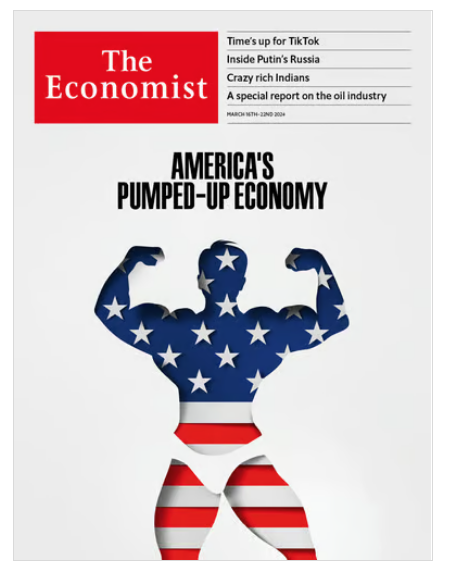
PPS. Public opinion polls (which I don’t trust) suggest that Americans view the US economy as “poor”. But the foreign media is in awe of the strength of our economy, in contrast to weaker economies in Europe and Asia: