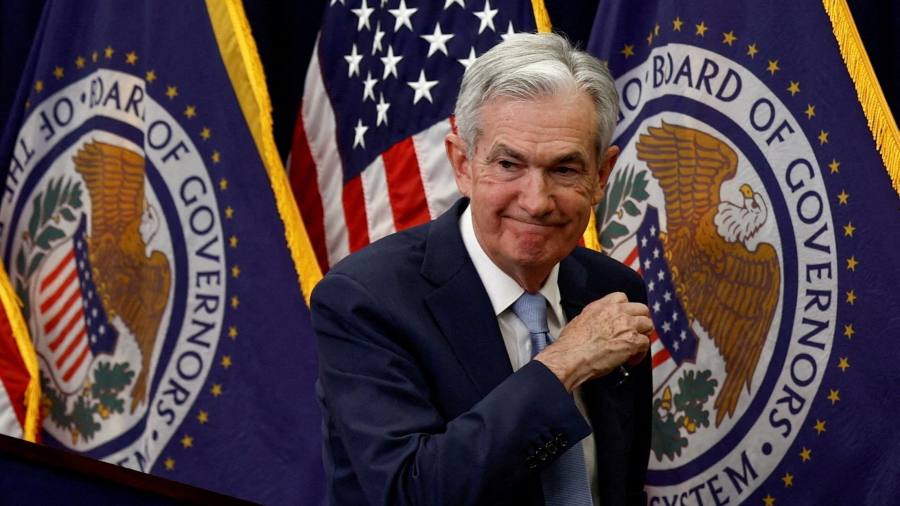

Equities, bonds, long-dated index-linked gilts, credit, crypto — the list of market horror stories in 2022 is extensive. Yet the biggest casualty this year was surely the reputation of big central banks.
In the period since the onset of the coronavirus pandemic and Russia’s invasion of Ukraine, their inflation forecasting has been dismally off-beam. Their response to the rapidly rising price level was slow and, in the notable case of the US Federal Reserve, initially timorous.
Central banking conventional wisdom held that it was necessary to “look through” supply-side shocks such as oil and gas price increases and closures of ports and semiconductor plants because their impact on potential output was transitory.
Yet it is clear that the supply shocks and inflation arising from factors such as deglobalisation will bring about a lasting reduction in potential output. In such circumstances, it is the job of monetary policymakers to tighten so demand is brought in to line with reduced productive capacity. One of the lessons of the cost-push inflation of the 1970s after the first oil price rise was that supply-side shocks can also, in central banker jargon, de-anchor inflation expectations and produce second-round effects in labour markets.
Recent monetary policy mistakes may in part reflect a collective generational memory loss. Very few of today’s central bankers were at the barricades fighting inflation after the oil shocks of the 1970s. Overconfidence after decades of low inflation was no doubt also a factor. As for the very timid initial move to tighten policy, it has to be said in fairness that it is notoriously difficult to assess an output gap in real time.
Lael Brainard, Fed vice-chair, points to the drawn-out sequence of shocks to the supply of labour, commodities and critical inputs such as semiconductors. This blurred the lines between what constitutes a temporary shock and a persistent one to potential output.
The outcome of all this is that central banks have lost authority. At the same time, their belated policy tightening is damaging their own balance sheets because rising yields are inflicting big mark-to-market losses on the huge bond portfolios acquired since the financial crisis of 2007-09.
Not all central banks will report these losses — there is considerable variation in reporting practice. Many will argue they are not profit-maximising institutions and can operate perfectly well with negative equity. They cannot go bust because they can print money.
Yet there can be a tipping point where markets fear that financial weakness will lead to high or hyperinflation. Turning to finance ministries for capital could reduce what independence central banks retain since the financial crisis. (This does not apply, incidentally, to the Bank of England, which sought and received an indemnity from the Treasury against losses in the crisis.)
Such is the uncertainty surrounding the condition of advanced economies that there is a risk of both monetary overkill and underkill. A move into recession in 2023 could expose financial fragilities arising from the long period of ultra-low interest rates in which investors searched for yield regardless of risk.
The working assumption among central bankers is that since the crisis bank balance sheets have strengthened but that risk has migrated to the non-bank financial sector. There is something in that, as the build-up of leverage in the UK pension system that was revealed in the September gilt crisis demonstrated.
But there are also big and very untransparent off-balance sheet risks in both the bank and the non-bank financial sectors, notably in relation to dollar debt in foreign exchange swaps, forwards and currency swaps. In a paper for the Bank for International Settlements, Claudio Borio, Robert McCauley and Patrick McGuire point out that $85tn in outstanding obligations to pay dollars in these instruments exceeds the stock of dollar Treasury bills, repurchase agreements and commercial paper combined.
The obligations, which have risen sharply since the financial crisis, are mostly very short term and often involve maturity mismatches in institutions such as insurers and pension funds. The resulting rollover needs make for dollar funding squeezes, as happened in the financial crisis and in March 2020 at the start of the pandemic. These dollar payment obligations do not appear on balance sheets and are missing in standard debt statistics. The scope for trouble here is obvious.
For the moment, a standard market view is that the central banks’ “tighter for longer” mantra will keep bond yields rising and equities falling. But the big question is whether, in the event of a funding crisis, central banks will feel obliged once again to return to asset buying to prop up markets and financial institutions, thereby weakening their anti-inflationary stance.
Such a U-turn would amount to central bank revisionism of a high order; in effect a return to morally hazardous asymmetric monetary policy. The worrying thing is that it is all too plausible.