
Early in my career, a Punjab farmer, upon my asking why he sowed paddy despite having to search deeper every year for water (thanks to a falling water table), said, “I will sow what you want, you just assure me a reasonable return.” That year, on a trip to Haryana, I asked a poultry farmer and an aggregator who procured from him how government policies facilitated their clearly satisfactory collaboration. They said the government did one thing right — it stayed out of it! Against the backdrop of the farmers’ agitation in the national capital, two points are underscored here: (i) In agriculture, the government isn’t needed everywhere, and (ii) assured incomes reduce farmers’ risk appetite over time.
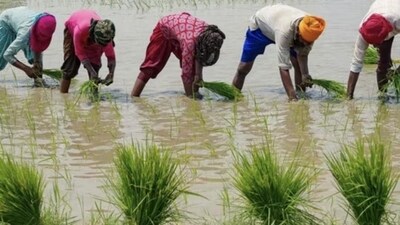
Punjab farmers’ inertia on crop diversification is well known. While they benefit from assured remunerative returns, they also tend to miss out on lucrative market opportunities. Just last year, non-basmati prices in most producer states exceeded the Minimum Support Price (MSP). But in Punjab and Haryana, they remained at MSP levels, limiting gains to their farmers.
High mandi levies are another of Punjab’s problems — no private player wants to buy at those rates (8.5%, versus no levy in Bihar and 2.2% in Madhya Pradesh). Consequently, the government becomes the residual buyer. It works for the Centre, too. It has to pay the high mandi levies but, given the state’s high irrigation coverage, it is able to procure as desired, drought or no drought.
Then, there is the question of politics. For instance, Punjab’s “free power to farms” policy — something no dispensation has shown the willingness to touch — reduces the effective cost of producing water-intensive crops like paddy, encouraging wider acreage for the crop. For ecological — and even economic — reasons, Punjab farmers must diversify to other crops. Unfortunately, they are out protesting, asking for, among other things, legislative guarantees for the MSP regime. There is a precedent for such a law: A fair and remunerative price (FRP) for sugarcane is mandated under the Essential Commodities Act 1955 (though, here, it is the sugar mills that pay, not the government). Of course, what FRP did to the sugarcane ecosystem is a conversation that has long fallen by the wayside. Yet, the agitating farmers are seeking a similar legal recourse for 22 crops!
Another demand is the implementation of the MS Swaminathan formula for calculating MSP, as per which farmers must get 50% over the comprehensive cost of cultivation (C2). The Commission for Agricultural Costs and Prices (CACP) sets the MSP by factoring in costs of seeds, fertiliser, hired labour, pesticides, machinery, and insurance, among others, together called A2. The imputed value of family labour (FL) is added. CACP adds a margin of 50% over these A2+FL costs. Farmers want this margin to be paid on the actual costs and the imputed value of their own capital and land.
There are profound systemic problems with these demands, especially when market demand and supply conditions don’t align. An unconnected increase in MSP, for one, prices out our exports. For instance, soybean’s high MSP has priced us out of soymeal exports. If we set such high MSPs, then we must brace for unviable value-chains.
Another fallout is high food inflation faced by the domestic consumer. How much inflation is acceptable to farmers and Indian consumers? High crop prices would inevitably lead to higher prices for consumers. And food inflation is the inflation component that matters the most. This threshold level of inflation remains a contentious issue, at least for the department of agriculture and the department of food and consumer affairs. While the former aims to secure high prices for farmers, the latter prioritises affordability for consumers. This lack of consensus has multifaceted implications — kneejerk policy reactions such as trade restrictions (export bans, stocking limits) and proposals of aggressive MSP increases being prominent among these. Given that 86% of Indian farmers are small and marginal ones and likely net consumers of agricultural commodities, what level of food inflation is acceptable to the nation? Concerns of both consumers and farmers have to be balanced. But to improve the incomes of farmers, is guaranteed MSP the right tool?
The proposal to set MSP at C2+50% is mostly unfeasible. Disregarding market dynamics harms the entire crop value-chain in the long-run. Instead of stifling the private sector and jeopardising export markets, we should aim for resilient, thriving markets. At the same time, while governments cannot replace markets, they must foster an environment conducive to the latter’s growth, by ensuring the resolution of any conflict or frictions that may arise and fair remuneration for farmers — maintaining fiscal integrity all the while.
To meet consumer and industry demands, the country must realign its production basket, prioritising crops like oilseeds, coarse cereals, maize, and pulses over rice and wheat. Aggressive MSP increases for these crops are, therefore, warranted, made all the more important due to rising import dependency for oilseeds and pulses.
Compelling traders to pay MSP for all crops has been attempted earlier (in Maharashtra, in 2018) and proven to be ineffective. Another solution that can be considered is a price deficiency payment system, where farmers are compensated directly for the price gap without any procurement by the government. Of course, here, the government must guard against cartelisation by market players to beat down prices.
Policy flexibility is crucial to prevent market prices from dipping below MSP due to cheaper imports. Recent instances of high food inflation made imports necessary, many of which landed in the country at prices below MSP. For instance, mustard. Cheaper palm oil and even sunflower oil imports are eating into the domestic oil market, making mustard at MSP unviable. Therefore, adaptive trade policies are critical. Policymakers must recalibrate duties to maintain domestic price parity.
Shweta Saini is an agriculture economist and founder-CEO of Arcus Policy Research. The views expressed are personal
This article was published in the Hindustan Times’ Print edition on February 22, 2024