Last week, citizen scientists working at the Mumbai-based non-profit Coastal Conservation Foundation reported large quantities of plastic pellets found on Mumbai’s beaches. Called nurdles, these plastics break down and enter the food chain, jeopardising the health of marine life and also those who consume them. This is, unfortunately, now a common story. Garbage, plastics, and oil spectacularly make their appearance on the shores of Mumbai, particularly in the monsoon.
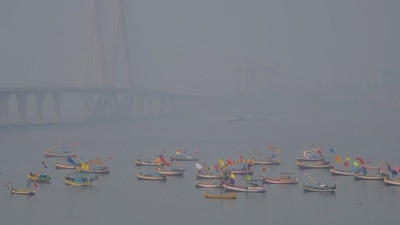
Mumbai’s sea, like other seas, is an “Anthroposea”: It is made up not just of water, tides, and non-human biota, but also of the matter and metabolic waste of its more than fifteen million human (and nonhuman) residents.
I developed the concept of the Anthroposea following recent work by geologists and humanists writing about the Anthropocene, which put simply, is a term used by scientists to refer to an era marked by how humans are affecting the earth’s biophysical systems at a planetary scale, from the oceans to the lithosphere and vital formations like ice sheets and monsoons.
As historian Dipesh Chakrabarty has argued, the Anthropocene collapses all assumed distinctions between the human sciences (such as politics, economics and history) and the natural sciences (such as ecology, geology, biology, and physics). Projects of big capital to intensify energy consumption, food production and urbanisation have transformed the planet to a degree that it is no longer possible to pretend there are any spaces of nature outside of human intervention.
Conversely, it is also impossible to pretend that humans can live independently and outside of the natural processes that these economic activities produce. Climate change, ocean acidification and deforestation will create zones of inhabitability in many parts of the world. Cities are not outside of, but central to, the Anthropocene.

Mumbai in the Anthroposea
Since 2015, I have been researching what the Anthropocene means for Mumbai, a post/colonial, coastal city built in the sea. In a recent paper published in the journal Society and Space, I argued that Mumbai dwells in the Anthroposea.
This has been in the making over the last three centuries. During this time, colonial and postcolonial administrators have engineered into being the city we now see on maps. Many of Mumbai’s neighbourhoods have been fabricated by desiccating wetlands and intertidal regions of the sea that have historically occupied them.
As the industrialising city grew rapidly on this fabricated ground, its rivers, sewage and stormwater systems have delivered increasing amounts of untreated sewage and industrial effluent into the sea to keep it dry.
As a result, today, the city’s coastal waters host high levels of heavy metals and oil. They are hypoxic and polluted, and host a changed ecology. In the Anthroposea today, a few species of mangroves, polychaetes, lobsters, jellyfish and flamingoes thrive. Culturally and commercially valuable fish species are more rarely found amidst its declining biodiversity.
The ongoing histories of the Anthroposea and the city do not just matter to fishers or fish. They also matter to those living their everyday lives on what is assumed to be firm ground. During the monsoon, waters from the sky and earth regularly reclaim neighbourhoods like Sion, Kalanagar, and Parel – neighbourhoods that were formerly wetlands. Stormwater engineers struggle to keep these historic wetlands dry, regularly proposing a panoply of Sisyphean projects that they know will be insufficient. Just as the city lives in the sea, the sea continues to live in the city.
And yet, for much of its history, the sea has been placed beyond the concerns of city officials and urban planners. In city plans, like the Mumbai Development Plan, the sea appears as empty, undifferentiated and homogenous, as a stable backdrop upon which the city is staged.
Planners and government officials do not attempt to understand, regulate or make policies for the sea. As they leave it be, they permit it to be filled with sewage, oil, solid waste and plastics. Urban officials require the sea to durably hold these matters in place, in ever deeper waters, without troubling the city. The sea is also expected to bear massive landfill projects along the coastline (such as the Coastal Road), without causing erosion or flooding in other locations. And the sea is expected to do all this work quietly while also providing safe food – fish, lobsters and crabs – to city residents.
Yet, today, amidst the extreme weather events of climate change, Mumbai’s Anthroposea is restless. Intensified rainfall, rising seas, “garbage tides”, oil spills and coastal sewage are now regular events, posing a threat to the health of their populations. The increased likelihood of cyclones, extremely heavy rain days and storm surges promise to inundate the city (with seawater and more), more intensely and more frequently.
The recent events in the Anthroposea that make the news – such as the nurdles appearing on a beach – raise questions about the future. For Mumbai to thrive, residents, planners and the government need to care for the sea, not least because the very possibility of living in Mumbai will depend on cultivating good relations with it.
Nikhil Anand is associate professor of Anthropology at the University of Pennsylvania. He advised on the Mumbai Climate Action Plan on Urban Flooding & Water Resource Management in 2021. He is the author of ‘Hydraulic City: Water and the Infrastructures of Citizenship in Mumbai’ (2017)
Experience unrestricted digital access with HT Premium
Explore amazing offers on HT + Economist