Much has been written about the wildfires that struck Hawaii on August 8 and reduced several towns, including the historic kingdom of Lahaina, to ash and caused an unquantifiable human loss. As of August 23, more than 1,000 people are still unaccounted for.
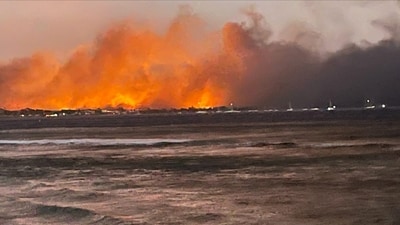
People native to the resort town turned to social media to express distress over the loss of lives, with some even urging people to rethink their vacation plans to an island whose economy is entirely dependent on tourism.
Actor-activist Jason Momoa, a native of Honolulu in Hawaii, put up a post on Instagram, saying, “Maui is not the place to have your vacation right now. Do not travel. Do not convince yourself that your presence is needed on an island that is suffering this deeply… That means the less the visitors on the island taking up critical resources that have become extremely limited the better.”
Momoa’s comments amid photos of tourists swimming at the beaches of Maui while the locals were still counting the dead.
The destruction of this picturesque town, a vacation spot so popular among white people that almost every other Hollywood movie makes a mention of it, has finally brought climate coloniality to popular discourse.
“The coloniality of climate seeps through everyday life across space and time, weighing down and curtailing opportunities and possibilities through global racial capitalism, colonial dispossessions, and climate debts,” Farhana Sultana, professor at Syracuse University, said in her paper The Unbearable Heaviness of Climate Coloniality.
In this paper published last year, Sultana argued that climate change and colonialism should be viewed together in order to understand the uneven effects of the crisis.
Climate coloniality, she said, not only takes material and political forms, but also discursive forms. Dominant discourses on studying and addressing climate change render “some lives and ecosystems…disposable and sacrificial, whereby [inequality-producing] structural forces, both historical and contemporary, fuel it”.
This coloniality is largely viewed in the context of the Global South, where the impact of the climate crisis is manifold and has been highlighted in popular media recently, even though their role is negligible when compared to the North.
“Climate coloniality is expressed in various forms, such as through fossil fuel capitalism, neoliberal growth and development models, and hyper consumptive and wasteful lifestyles, but also through structures, systems, and epistemologies built and held in place by powerful alliances globally,” Sultana said.
But the crisis in Hawaii and the US population’s response to it has shown that ‘the white man’ may be burdening the lands of the indigenous, even within the land he calls his own.
Along with news reports on Hawaii, social media was also rife with photos of people and cadaver dogs digging through the ashes looking for valuables, and more distressingly, their family members.
Alongside those images, were pictures of holidayers on the beaches on the other side of the island.
“The same waters that our people just died in three days ago are the same waters the very next day these visitors – tourists – were swimming in,” one local told the BBC. “That says a lot about where their heart and mind is through all of this, and where our heart and mind is now.”
A post on X, formerly Twitter, by New York Times journalist Kellen Browning, about a white woman holding a burnt, yet legible, Rolex in her perfectly manicured hands on the rubble of her holiday home in Lahaina only reinforced this callous ignorance of the indigenous people’s lives.
NYT’s roundup article described a condo resident’s “unreal discovery of her diamond earrings among the twisted wreck of her Peloton bike and other belongings”.
But these attempts at presenting the disaster as a great equaliser laid bare the stark inequalities.
The Indigenous Hawaiians will suffer long-term impacts of the fire that is still raging in some parts, as holidayers will return to the comfort of their homes.
Local reports suggested that the residents of Lahaina were already receiving cold calls from real estate agents prodding them to sell their ancestral lands rather than wait for compensation and insurance claims.
The locals could also lose their rights to the water – a commodity that was missing in fire-fighting operations but still filled the pools in 5-star resorts owned by non-islanders (anyone looking for an insight on these resorts need only watch The White Lotus on HBO).
The tactics, better known as disaster capitalism, are employed to exploit moments of extreme collective trauma to rapidly push through unpopular laws that benefit a small elite relying on the cruel dynamic between needs during an extreme situation.
For decades now, water across the western region of the island has been extracted to benefit the interests of sugar plantations and their corporate successors, Naomi Klein and Kapuaʻala Sproat wrote for The Guardian.
These corporates have devoured the island’s natural resources to develop mansions, colonial-style subdivisions, luxury resorts and golf courses where cane and pineapple once grew.
This plantation economy has taken a toll on the water in the area, draining Indigenous ecologies of their natural moisture. Hence, Lahaina, once the Venice of the Pacific, has turned into a parched desert increasing its vulnerability to fire.
These instances bring us back to Sultana’s conclusion: “Institutional unaccountability, anthropogenic hegemony, neocolonial approaches to ‘resources’, coloniality of global governance structures – all combine to create colonialities of climate.”
At the time of such disasters, local governments often look to private lenders and other countries for aid.
But if a recent analysis is to be believed, this might be another pitfall.
A new analysis has revealed that countries in the Global South are trapped in relying on fossil fuel production to repay debts.
The report by Debt Justice said that these countries are spending five times more on repaying debts than they are on addressing the climate crisis, with external debt payments increasing by 150% between 2011 and 2023, and reaching their highest levels in 25 years.
Several countries may find it impossible to phase out fossil fuels and transition to renewable, sustainable energy sources, unless this “debt-fossil fuel trap” is addressed, the report said.
Governments of developed countries in 2009 committed to providing $100 billion in climate finance every year to developing countries by 2020. In 2015, this commitment was renewed with a $100 billion pledge every year between 2020 and 2025. Both are well below what is needed for adaptation and mitigation.
And yet, most of the $10 billion in financial assistance provided to Pakistan after last year’s floods was in the form of loans.
The report said many climate-affected countries needed more access to grants to pay for the effects of changing climate, as many are forced further into debt to pay for repairs after cyclones and floods.
“The climate and debt crises emerged from the same system that is based on the Global North’s relentless extraction of human, economic and environmental resources to feed the drive for profit and greed. These mutually reinforcing crises are playing out in terms of lives lost and livelihoods eroded, not only for millions of people today, but also for generations yet to come,” Mae Buenaventura, debt manager at the Asian People’s Movement on Debt and Development, said in a statement.
“Surely, debt cancellation especially of fossil fuel debts, is the least that rich countries and lenders can do to repay the Global South, to make reparations and bring about restitution as a matter of justice,” she added.