Authored by Pepe Escobar,
The New Silk Roads, or BRI, as well as the integration efforts of BRICS+, the SCO and the EAEU will be on the forefront of Chinese policy...
Liu He studied economics at Renmin University in China and got a Master’s from Harvard. Since 2018, he’s one of China’s Vice Premiers – along with Han Zheng, Sun Chunlan, and Hu Chunhua. He’s a Director of the Central Financial and Economic Affairs Commission and heads the China Financial Stability and Development Committee. Anyone around the world who wants to know what will drive China’s economy in the Year of the Rabbit must pay attention to Liu He.
Davos 2023 has come and gone: an extended exercise in Demented Dystopia with peaks of paroxysm.
At least a measure of reality was offered by Liu He’s address.
A limited but competent analysis of what he said is infinitely more useful than torrents of barely disguised Sinophobic “research” vomited by U.S. Think Tankland.
Liu He pointed to some key numbers for the Chinese economy in 2022. Overall 3% growth may not be groundbreaking; but what matters is value-added for high-tech manufacturing and equipment manufacturing going up by 7.4% and 5.6% respectively. What this means is that Chinese industrial capacity continues to move up the value chain.
Trade, predictably, reigns supreme: the total value of imports and exports reached the equivalent of $6,215 trillion in 2022; that’s an increase of 7.7% over 2021.
Liu He also made it clear that improving the wealth of Chinese citizens remains a key priority, as enounced in the 2022 Party Congress: the number of middle class Chinese, by 2035, should jump from the current 400 million to an astonishing 900 million.
Liu He pointedly explained that everything about Chinese reforms revolves around the notion of establishing “a socialist market economy”. This translates as “let the market play a decisive role in resources allocation, let the government play a better role.” That has absolutely nothing to do with Beijing privileging a planned economy. As Liu He detailed, “we will deepen SOE [State-Owned Enterprises] reform, support the private sector, and promote fair competition, anti-monopoly and entrepreneurship.”
China is reaching the next level, economically: that translates as building, as fast as possible, an innovation-driven commercial base. Specific targets include finance, tech, and greater productivity in industry, as in applying more robotics.
On the fin-tech front, a resurgent Hong Kong is bound to play an extremely important role starting by 2024 – most of it in consequence of several Wealth Management Connect mechanisms.
Enter, or re-enter the key role of the Guangdong-Hong Kong-Macao Greater Bay Area – one the key development nodes of 21st century China.
What is known as the Greater Bay Area’s Wealth Management Connect is a set up that allows wealthy investors from the nine mainland cities that compose the area to invest in yuan-denominated financial products issued by banks in Hong Kong and Macao – and vice-versa. What this means in practice is opening up mainland China’s financial markets even further.
So expect a new Hong Kong boom by 2025. All those dejected by the collective West’s morass, start making plans.
Dual circulation hits Eurasia
As expected, Liu He also referred to the key Beijing strategy for this decade: “A new development paradigm with domestic circulation as the mainstay and domestic and international circulations reinforcing each other.”
The dual-circulation strategy reflects the Beijing leadership’s emphasis on simultaneously boosting China’s self-reliance and its vast export market footprint. Virtually every government policy is about dual circulation. When Liu He talks about “spurring of China’s domestic demand” he’s sending a direct message to global exporters – Eastern and Western – focusing on this ever-growing, gigantic mass of Chinese middle class consumers.
On the geopolitical and geoeconomic Big Picture, Liu He was diplomatically circumspect. He just let it filter that “we believe that an equitable international economic order must be preserved by all.”
Translation: the New Silk Roads, or BRI, as well as the integration efforts of BRICS+, the SCO and the EAEU will be on the forefront of Chinese policy.
And that brings us to what should become one of the key stories of the Year of the Rabbit: the renewed drive along the New Silk Roads.
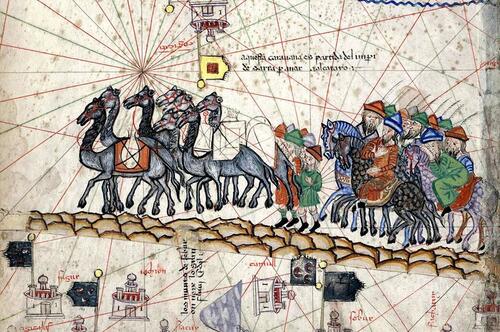
Few better than the Chinese, historically, understand that from Samarkand to Venice, from Bukhara to Guangzhou, from Palmyra to Alexandria, from the Karakoram to the Hindu Kush, from deserts that used to engulf caravans to gardens of secluded harems, a formidable pull of economic, political, cultural and religious factors not only linked the extremities of Eurasia – from the Mediterranean to China – but determine and will continue to determine its centuries-old history.
The Ancient Silk Roads were not only about silk but also spices, porcelain, precious tones, fur, gold, tea, glass, slaves, concubines, war, knowledge, plagues – and that’s how they turned into the symbol of Eurasia-wide “people to people exchanges”, as Xi Jinping and the Beijing leadership extol it today.
These processes involve archeology, economics, history, musicology, compared mythology; so, keeping up with the past, the New Silk Roads also mean all manner of exchanges between East and West. The perpetual history of non-stop trade, in this case, is only the material base, a pretext.
Before silk there was lapis lazuli, copper, incense. Even if China may have only opened itself to the outside world on the 2nd century B.C. – because of silk – Chinese tradition, in the oldest Chinese novel, The Chronicle of the Son of Heaven Mu, tells the tale of Emperor Mu visiting the Queen of Sheba already in the 10th century B.C.
The exchanges between Europe and China may have started only in the 1st century B.C. The men who actually traversed the Eurasian immensities were actually few. It’s only in the year 98 that the Chinese ambassadorship of Gan Ying departs for Da Qin – that is, Rome. He never arrived.
In the year 166, the Antoninus Pius ambassadorship, allegedly sent by the Emperor himself, finally hits China; but in fact that’s just an adventurous merchant. For 13 centuries there was a huge exploratory void.
Despite the prodigious advances of Islam and the omnipresence of Muslim merchants since the 7th century, it’s only in the 13th century – at the time of the last Crusades and the Mongol conquest – that Europeans picked up again the road towards the East. And then, on the 15th century, the Ming emperors succeeding the Mongols totally closed China to the outside world.
It’s only due to a certain extent to the Jesuits in the 16th century that a meeting finally happened – 17 centuries too late: Europe finally started to acquire some knowledge of China, even as it dreamed about it over and over again, since chic Roman patricians were enveloped in transparent silk robes.
It’s only around 1600 that Europeans seem to have become aware that Northern China and Southern China are on the same continent. So we may conclude that China really became known in the West only after the “discovery” of the Americas.
Two worlds ignored each other for so long – and still, all along the watchtowers in the middle of the steppes, trade kept moving from one side of Eurasia to another.
Now it’s time for another historical push – even as a discombobulated Europe is kept hostage by a cabal of imperial Straussian neo-cons and neoliberal-cons. Duisburg, in the Rhur valley, the world’s largest inland port, after all remains the key Iron Silk Road hub across BRI, linked by endless railways to Chongqing in China. Wake up, Young German: your future is in the East.