

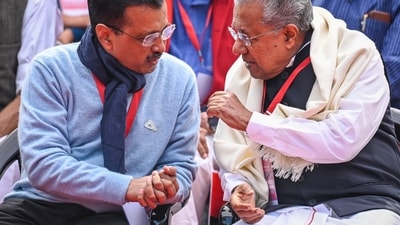
Last week, the chief ministers (CMs) of three southern states alleged discrimination by the Centre in the allocation of funds to states. Speaking at a protest in Delhi, Karnataka CM Siddaramaiah mentioned that the state gives ₹100 (in terms of revenue) to the Centre, but gets back only ₹13. Finance minister Nirmala Sitharaman has responded to the allegations saying that Karnataka got all the allocated funds agreed upon. Further, Sitharaman clarified that the devolution of funds to the states is done based on the recommendations of the Finance Commission and she has no discretion in the allocation of tax funds.
It is not the first time we have seen the southern states protest over tax allocations. The 11th Finance Commission report submitted in 2000 reduced the percentage share for high- and middle-income states in the total tax. In the wake of that report, Chandrababu Naidu, then Andhra Pradesh CM and a key member of the Atal Bihari Vajpayee-led NDA coalition, complained about the Commission’s recommendations. He led a public protest of eight high- and middle-income states in August 2000. They challenged the traditional role of the Finance Commission as a federal equaliser, condemning it for encouraging fiscal and reproductive profligacy.
The existence of wide inter-state disparities in a vast country like India is well recognised. South Indian states have achieved higher economic growth and human development. Similarly, states in the western region have done well in economic growth. Industry, infrastructure and high-income services are concentrated here. Credit, private investment including foreign direct investment, and exports are higher in these states. Similarly, state capacity in implementation is also better. As a result, the per capita Gross State Domestic Product (GSDP) is high in both southern and western parts of India. On the other hand, per capita GSDP and human development are low in several states to the north of the Vindhyas. Apart from low private investment, state capacity in spending and implementation is also relatively low in these states.
Empirical evidence shows that inter-state disparities in per capita GSDP are diverging rather than converging. In contrast, the regional disparities in human development such as literacy, school enrolment, infant mortality and life expectancy seem to be converging. This is not surprising as less developed states will catch up with developed states in human development indicators, as there are asymptotic limits for these criteria. Moreover, many of the poorer states could contribute more to economic development because of the demographic dividend. The share of the old age population in Bihar is likely to be 8%, while it would be 17% in Kerala by 2036.
Whether the constitutionally mandated Finance Commission, appointed every five years to recommend the allocation of taxes between the Centre and states and among states, are agents of profligacy or discipline is a subject of debate. Politicians and civil servants from southern and western India see them as protectors of fiscal irresponsibility and population expansion.
Traditionally, as heirs of the redistributive philosophy of the founding generation, the Finance Commission has been seen as the rectifier of unacceptable disparities among the states. At the same time, the concerns of the states in southern India have to be addressed. There is a feeling among them that they are being penalised for better performance. Also, the terms of reference of the 15th Finance Commission were quite contentious as it was asked to take into account 2011 population figures instead of 1971 numbers.
For every rupee they contribute to the Centre’s taxes, the southern and western regions get back less than a rupee, while the less developed states in the north and east get much more than a rupee. In a large diverse country like India, cross-subsidisation of poorer states by developed states is inevitable and acceptable. However, the share of Union taxes for southern states has declined from 21.1% in the 11th Finance Commission to 16% in the 15th Finance Commission. Given the North-South divide in the performance and widening gap, how long will the southern states accept this arrangement? Another political issue is that the delimitation due in 2026 will result in a reduction in parliamentary seats of the southern states. It is a double blow for southern India, which is performing well in development with low growth of population. The South is also unhappy with the “one-size-fits-all” approach to centrally sponsored schemes.
What is the solution? There is no easy remedy for this political challenge. The 16th Finance Commission should consider the continuous fall in the share of southern states and make suggestions for compensating them. As this North-South divide keeps coming up frequently, the Centre and the states have to discuss and decide the optimum path for resolving this problem. One can think of setting up a stabilisation fund, which can be distributed as grants when there is a significant fall in the share of Union taxes. Innovations in Goods and Services Tax would also help. Setting up an independent fiscal council could be useful for discussing these issues. Basically, we have to find an answer for incentivising the better performing states while giving a legitimate share of taxes to the less-developed states in the North.
Despite progressive central transfers, inter-state disparities in income are increasing. In other words, competitive market forces are helping the developed states to grow faster. The low-income states should not be complacent because of higher transfers. These states should develop physical infrastructure, human capital, and state capacity and attract private investment. Bifurcation of large states into smaller states may also lead to better development. The medium-term solution is that states should converge in per capita income. This should lead to some equalisation of shares of Union taxes between the North and the South.
S Mahendra Dev is distinguished professor, ICFAI, Hyderabad and former vice chancellor, IGIDR, Mumbai. The views expressed are personal