The Red Sea crisis is growing — on February 19, the European Union announced its own naval mission to protect shipping in the Gulf of Aden. The nature of disruption caused by the Houthis since December 2023 means that the Arab peninsula is now pincered by two naval theatres — the Gulf and the Sea.
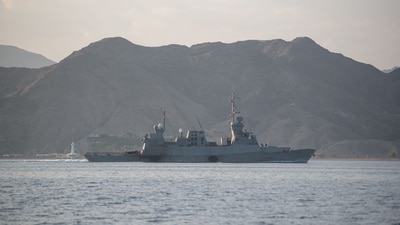
The Houthis of Yemen have engaged in direct conflict with US warships in the Red Sea, and off the Sea’s southern choke-point, the Bab-el-Mandeb. These are occurring alongside attacks on cargo ships that the American and European warships seek to protect. While this sector of the northern Indian Ocean has always witnessed naval conflict, the present engagements are different.
Notwithstanding operations against Somali pirates (more law-enforcement, less political), the primary naval threat that the US ships have faced in the region has been speedboats of Iran’s Islamic Revolutionary Guard Corps (IRGC). The past two decades have featured recurrent harassment, hostile manoeuvring and sometimes, even direct engagement between US and Iranian vessels. The sites for these have usually been the Persian Gulf, and its Southern choke point, the Strait of Hormuz. The US Central Command is based out of Bahrain, proving the Gulf’s high-priority focus for American geopolitical interests. The last major IRGC-US Navy face-off happened in August 2023, and these occasional naval skirmishes disrupt (but do not upend) the oil trade between Gulf states and the world.
The Red Sea is a different story.
Unlike the Persian Gulf, the Red Sea provides access to the Mediterranean Sea in the North (and thus to Europe) through the Suez Canal, making it considerably more economically vital than the Persian Gulf for all trade, oil and beyond. The Canal’s vitality and the degree to which international shipping could be held hostage was proven during the 1956 Suez crisis, in 2021, we saw the results of traffic disruption from and to the Mediterranean when the MV Ever Given ran aground in the Canal. The alternative to using the Red Sea via Suez is to sail about 6,000 kilometres around Africa, turning at the Cape of Good Hope. While crude supply to India (especially Russian which primarily relies on the Red Sea route) has not been grossly affected yet, increasing shipping costs adversely affect all oil-importing states.

New risks to the global economy
The Houthi attacks are unprecedented in scope (with their primary focus on US and British warships and international shipping) and scale (with anti-ship ballistic missiles being used against US warships by a non-state actor for the first time ever). Prior to November, the Houthis’ principal rival had been the Saudi Arabia-led Arab coalition, backing opposing factions in the Yemeni civil war. US warships were rarely the direct target of attack for the Houthis.
This makes the Red Sea the second locus of conflict in the Middle East currently (besides Gaza). A New York Times report, quoting Spire Global, shows the extent to which maritime trade has been rerouted, forcing shipping firms to charge significantly higher costs to go around Africa, and exorbitant insurance premiums to continue using the Red Sea. The damage is felt worldwide, with global inflation pegged to rise by 0.7%.
Even as most Arab states stand by and Iran increases its naval presence in the Red Sea, the immediate mitigating measure for the US and allies has been a kinetic one — to strike the Houthis in Yemen and force a military resolution to the crisis. Thus far, it has yielded limited gains, by President Joe Biden’s own admission. The US has refused to acknowledge the Houthis’ stated casus belli of their attacks being a response to Israel’s Gaza bombardment (and thus ideally requiring Western states to diplomatically push Israel to end the war).
Note that the Houthis are just coming off a decade-long war with Saudi Arabia, with the latter having relied heavily on air strikes and now actively looking to exit the war.
Even if a ceasefire agreement in Gaza — palatable both to Hamas and Israel — is achieved, the Red Sea crisis is likely to linger for longer.
Locus of change
In the months leading to October 7 — when Hamas attacked Israel killing over a thousand people and injuring several more — the political landscape of the Middle East was already better. While Arab states were increasingly warming up to Israel (economically first and then diplomatically), intra-Arab conflict was fading. Old wounds were sought to be closed with the China-brokered Saudi-Iran rapprochement, Bashar-al-Assad’s Syria being welcomed back into the Arab League after a decade of civil war, and Qatar previously being re-inducted into the Arab fold — ending the years-long diplomatic face-off between Doha and Arab capitals.
Indeed, just a week before October 7, the US National Security Advisor remarked that the “Middle East is quieter today than it has been in two decades”. Now, besides the war in Gaza where Israeli bombardment has killed close to 30,000 thus far, the Red Sea crisis shows these states that the re-igniting of old fault lines (Israel-Hamas) can hurt, but the spillover effects can cause more harm, forcing a re-thought on how older relationships are to be managed, even as they continue to focus on greater regional stability.
For Washington itself, the Middle East has changed. Even as its broader conflict with Iran escalates, amidst a snail-paced mistrust-laced effort to rejuvenate the older US-Iran nuclear deal, its Arab allies are showing increasing openness to Beijing. China, which already became Riyadh’s largest trading partner by late 2022, has significantly expanded its cross-sectoral partnership with Saudi Arabia, making the relationship stronger than ever before. Along with other Arab states, China’s cross-Gulf influence was proven when it acted as a broker between Riyadh and Tehran, signifying the depth of the Iran-China relationship simultaneously.
From the first days of the current Gaza crisis, Beijing has vocally sided with Arab states and Palestine, against Israel, and ensured its own naval presence in the region by re-deploying its 44th naval escort taskforce (but staying largely clear of US warships).
Note that China’s only extra-territorial naval base (or logistics facility) is in Djibouti — at the mouth of the Red Sea. Diplomatically, economically, and militarily, Beijing today is very much a shaper of Middle Eastern geopolitics. However, even as the United States remains the primary extra-regional power in the Middle East, Washington itself has been forced to acknowledge Chinese influence. On January 24, US officials directly asked Chinese officials to urge Tehran to rein in its proxy groups (such as the Houthis) to end the Red Sea crisis. While a US-China agreement on the issue has not been forthcoming thus far, Washington and Beijing continue to focus their engagement on the Houthi crisis. The Red Sea, then, is the eye of the storm today, with its winds changing Middle Eastern geopolitics for actors both within and without the region.
Bashir Ali Abbas is a research associate at the Council for Strategic and Defense Research, New Delhi, and a South Asia Visiting Fellow at the Stimson Center, Washington DC. In Eye on the Middle East, Bashir writes about the Middle East/West Asia region and its larger implications for India. Views expressed are strictly personal