Spying an empty spot in a parking lot, a driver flicks on the turn signal and steers the car into the space. This little maneuver happens so often across the country that it’s done almost without a second thought.
But now, the humble parking spot is suddenly a hot topic. Scrutinizing their parking regulations, cities across the nation are rolling back requirements for new development.
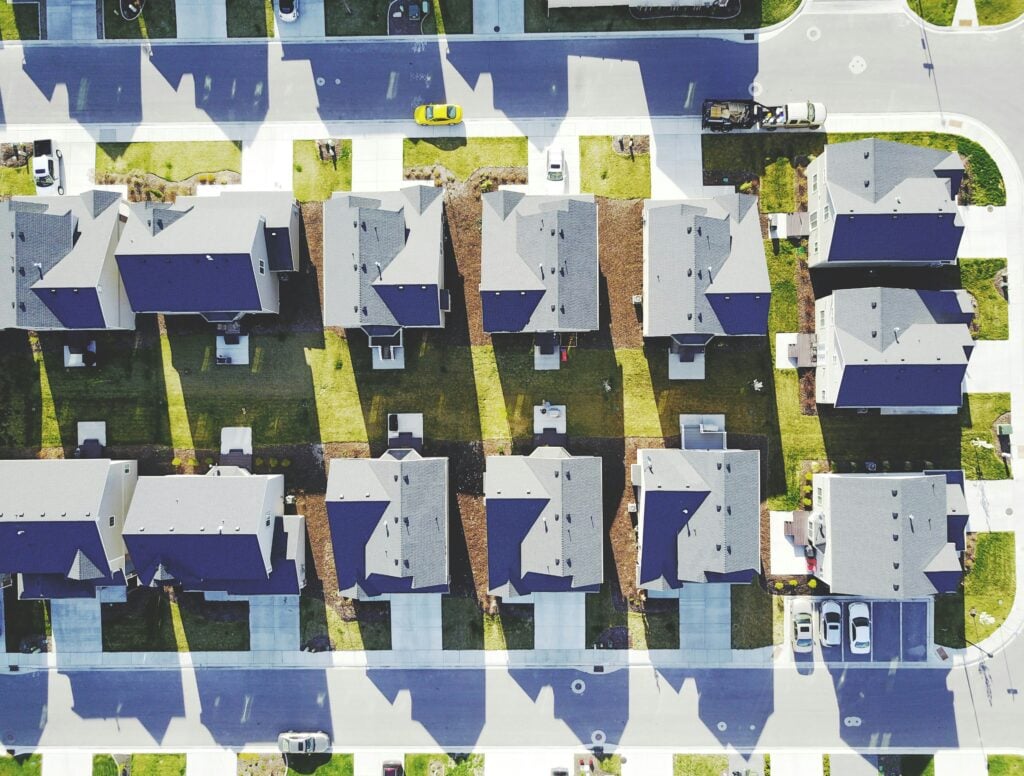
The United States has about 2 billion parking spots, according to some estimates — nearly seven for every car. In some cities, as much as 14% of land area is covered with the black asphalt that engulfs malls, apartment buildings and commercial strips.
The fact that the country is awash in parking spots stems from America’s long-standing love affair with the car, compounded by arcane zoning codes that mandate off-street parking for real estate projects.
But paving over paradise, to paraphrase Joni Mitchell, is now being blamed for a number of societal woes, including the housing crisis, climate change and the rise in fatalities among pedestrians and cyclists.
The idea that the country has an overabundance of parking may come as a surprise to residents of big cities like Chicago, New York and Washington, where drivers are routinely hunting for a spot and sometimes even get into fights over parking spaces. Some worry that rolling back mandates may make it even harder to find that coveted spot.
But in city after city, minimum parking requirements, as they are called, are being struck down, thrilling progressives and real estate developers alike. “It’s snowballing,” said Jeff Speck, a city planner and the author of “Walkable City: How Downtown Can Save America, One Step at a Time.”
Despite pushback from some residents not ready to share their favorite spot, hundreds of cities, from Gainesville, Florida, to Anchorage, Alaska, have overhauled their parking requirements. Dozens have repealed them — 15 in 2022 alone.
Changes in work modes may be coming into play: The rise in popularity of remote and hybrid work arrangements means fewer office workers are commuting daily, decreasing the need for parking.
Priscilla Barolo of Carmel, California, found she no longer needed a parking spot when she started her own consulting business from home, giving up a communications job at Zoom — and a commute that took an hour each way, which cut into the time she spent with her two young sons. “Remote is going to be my future,” Barolo said.
The move to reduce parking lots has particular relevance for real estate. “We think it’s the future,” said Dirk Aulabaugh, an executive vice president at Green Street, a real estate analytics firm.
Off-street parking sprang up in the 1920s with the rise in car ownership. Concerned that there would not be enough curb space for vehicles, towns and cities started to require that stores or apartment complexes provided parking for customers and tenants.
In the postwar period, when Americans were in thrall with the automobile and the federal government unfurled highways across the land, parking minimums were enshrined in zoning codes to ensure that drivers would always find a paved parallelogram waiting for them at the end of their trip.
The rules were exacting: one parking space per apartment, for example, or one for every 300 square feet of a commercial building. It all sounded scientific, but these ratios were not based on any verifiable data about how many spaces were needed, said Donald Shoup, a professor of urban planning at UCLA, who has been railing since the 1970s against the requirements, which he calls a pseudoscience.
Nevertheless, towns copied the rules from other towns until the requirements were codified across the country, and people started to think of free parking as a right. No wonder there’s even a spot for it on the Monopoly board.
But parking mandates encourage car ownership and use, Shoup said. They pockmark downtowns with stretches of asphalt that separate businesses and spread out cities, leading to more driving and more parking, even in areas with mass transit.
The mandates also constrain developers, who need to allot precious space to parking, driving up costs that are often passed on to tenants and customers. Even a basic, stand-alone parking structure costs nearly $28,000 per spot on average, not including land, said Rob McConnell, a vice president at WGI, an engineering firm. And underground parking costs twice as much, he added.
Some developers would include space for parking even if it was not mandated, believing the success of their projects depended on it. Others petition for variances, a time-consuming undertaking.
Officials in Buffalo, New York, decided there had to be a better way. In 2017, the city eliminated minimum parking mandates for new developments, leaving it up to developers to figure out how much to provide. A 2021 study revealed that after the repeal, 47% of major developments provided 21% fewer spaces on average.
And projects in Buffalo that might not have been feasible before the repeal suddenly were, including one with affordable apartments that was built, coincidentally, on a former parking lot.
Other cities — seeing that “the sky did not fall,” as Shoup put it — followed suit. Some reduced minimum requirements; others did away with them altogether; and still others went so far as to set parking maximums, according to the nonprofit group Parking Reform Network, which has been tracking the moves. Instead of parking, some developers provided allowances for mass transit and bike use or rental-car-sharing arrangements.
Overturning the requirements is not the only way parking lots are being refashioned. There have been efforts to landscape them with plants to absorb rainfall rather than letting it run off, which can cause flooding. The greenery can also reduce heat radiating from the asphalt. Some lots have been transformed into parks, while others are topped with solar panels to provide power as well as shade.
Not everyone is a fan of the reforms. Those with disabilities need to be able to park close to where they are going, McConnell of WGI said. Much of the time, however, objections to repealing minimums come from homeowners who fear their neighborhoods will be overrun with cars.
In South Boston, mandates were increased in 2016. Last year, Miami reinstated minimum parking requirements. “This is not a pedestrian and bicycle city,” said one commissioner who complained of people parking in front of his house.
But the momentum is in the other direction, driven in part by a housing shortage, which has prompted officials to explore ways to ease construction requirements and make homes more affordable.
In December, San Jose, California, became the largest U.S. city to eliminate parking minimums. Bend, Oregon, repealed its minimums this year.
In some cities, the amount of parking may already exceed demand, according to a 2018 inventory commissioned by the Research Institute for Housing America, part of the Mortgage Bankers Association. The survey showed that there were 19 parking spots per household in Des Moines, Iowa, and that in Jackson, Wyoming, there were 27 spaces for every home.
There’s action at the state level, too. California recently capped parking in cities with robust mass transit, and Oregon capped it for cities of a certain size. In New York, a bill in committee would prevent cities, villages and towns from imposing exclusionary zoning, including parking minimums.
And legislation introduced at the national level, known as the Yes in My Backyard Act, would require recipients of certain federal funds to show that they were eliminating or reducing barriers to affordable housing, including off-street parking requirements.
“We need more housing. We need more density in certain cities,” Aulabaugh of Green Street said. “Converting parking or lowering the parking requirement, that’s how you get there.”
Even on Black Friday, traditionally the busiest shopping day of the year, there might be more than enough parking spaces for shoppers now that so many people buy presents online during the holiday season. To raise awareness of the glut, the nonprofit organization Strong Towns started a #BlackFridayParking social media campaign; every November, photos of half-empty lots are tagged. Indeed, outer edges of lots around malls are now being regarded as a kind of land bank for future development.
Those parking spots may not be missed when they’re gone, given the decline in car ownership among millennials coupled with changes in transportation modes, including ride-hailing, car-sharing, and electric bikes and scooters.
Dr. David Rosen, a physician who specializes in sleep disorders, doesn’t need a parking spot when he bikes from his home in Tenafly, New Jersey, to a hospital in New York’s Bronx borough where he works in an intensive care unit once a week. “Arriving by bike is a fantastic feeling,” he said.