The crew is expected to lose contact with Earth for about 40 minutes Monday while they’re behind the far side of the moon, also setting a new distance record.
WASHINGTON — The crew of the Artemis II mission are set to make history yet again on Monday, when the four astronauts aboard the Orion loop around the moon at the farthest distance from Earth ever traveled by humans.
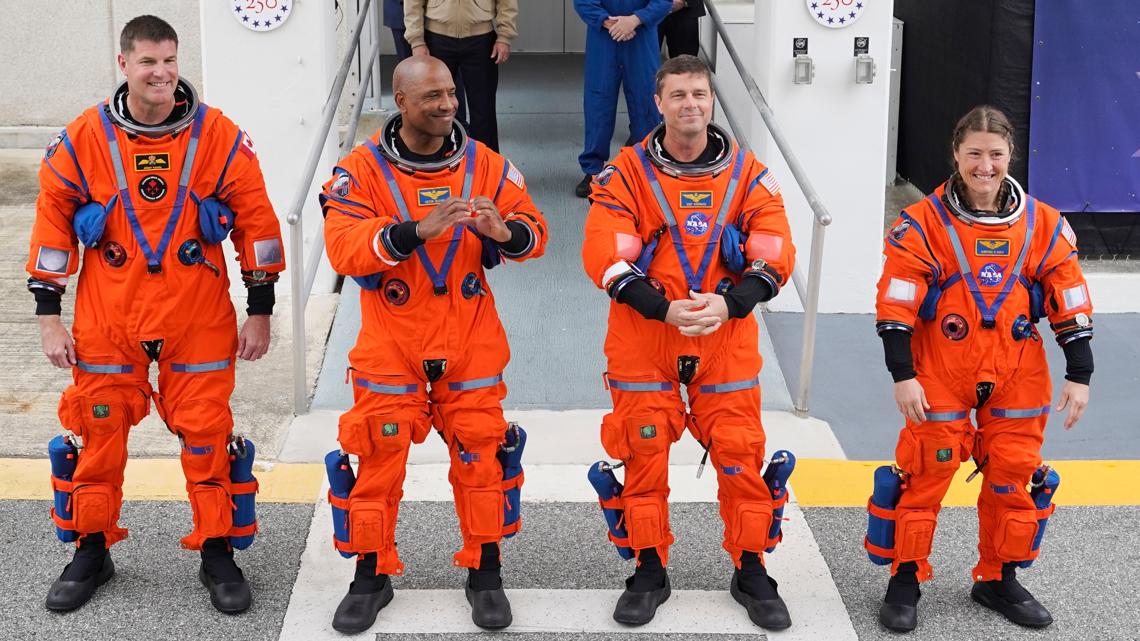
Astronauts Reid Wiseman, Jeremy Hansen, Christina Koch and Victor Glover will also get a chance to see a total solar eclipse during the flyby.
The Artemis II rocket lifted off Wednesday evening from the Kennedy Space Center in Florida for the roughly 10-day trip around the moon.
It’s the first time humans have been near the moon in more than 50 years, and they will break the record for the farthest distance from Earth set in the 1970s during the Apollo 13 mission.
NASA released a detailed plan for Monday, when the Orion spacecraft will loop around the far side of the moon before making its return to Earth.
The spacecraft is expected to lose all contact with Earth for roughly 40 minutes while the moon blocks transmissions.
NASA notes that the exact time of events is subject to change, and all events are listed in Eastern Time.
Moon fly-by schedule for Monday, April 6
- 12:41 a.m.: Orion enters lunar sphere of influence
- 2:20 a.m.: Crew sleep begins
- 10:50 a.m.: Flight Day 6 begins, crew wake up
- 1 p.m.: NASA+ coverage of lunar flyby begins.
- 1:56 p.m.: The crew will surpass the record for human’s farthest distance from Earth previously set by Apollo 13, at 248,655 miles from Earth.
- 2:10 p.m.: Crew remarks about Apollo 13 distance record (audio only)
- 2:15 p.m.: Crew configures Orion’s cabin for flyby operations
- 2:45 p.m.: Lunar observation period begins
- 6:47 p.m.: Predicted loss of communications as crew heads behind the moon (estimated 40 minutes)
- 7:02 p.m. Orion closest approach to the moon
- 7:05 p.m.: Orion reaches maximum distance from Earth
- 8:35 p.m.: Orion enters period with moon eclipsing the sun
- 9:20 p.m.: Lunar observation period (flyby) concludes
- 9:32 p.m.: Solar eclipse period concludes
- 10:50 p.m.: Live downlink event
Total solar eclipse in store during moon flyby
The upside of the April 1 launch is a total solar eclipse. The eclipse won’t be visible from Earth — only from the Orion capsule — treating the astronauts to several minutes’ worth of views of the sun’s outermost, radiating atmosphere, the corona.
The astronauts will be on the lookout for any unusual solar activity during the eclipse and will use their “unique vantage point” to describe the features of the solar corona, or crown.
All four astronauts packed eclipse glasses to protect their eyes.
Brief blackout behind the moon
Orion will be out of contact with Mission Control for nearly an hour when it’s behind the moon. The same thing happened during the Apollo moonshots.
NASA is relying on its Deep Space Network to communicate with the crew, but the giant antennas in California, Spain and Australia won’t have a direct line of sight when Orion disappears behind the moon for approximately 40 minutes.
These communication blackouts were always a tense time during Apollo although, as flight director Judd Frieling points out, “physics takes over and physics will absolutely get us back to the front side of the moon.”
Homeward bound for Artemis II after moon flyby
Once Artemis II departs the lunar neighborhood, it will take four days to return home. The capsule will aim for a splashdown in the Pacific near San Diego on April 10, nine days after its Florida launch.
During the flight back, the astronauts will link up via radio with the crew of the orbiting International Space Station. This is the first time that a moon crew has colleagues in space at the same time and NASA can’t pass up the opportunity for a cosmic chitchat. The conversation will include both members of the first all-female spacewalk in 2019: Koch aboard Orion and Jessica Meir, on the station.
The Associated Press contributed to this report.