

Astronomers recently announced that they could “hear” the “murmur” of the Universe wafting across aeons of time and space using the best clocks in our Galaxy — radio pulsars, which are highly magnetised rotating stars. This exciting find is the culmination of decades of work and opens a new era in gravitational wave astronomy.
The notes were “heard” by five international experiments, including the Indo-Japanese experiment called the Indian Pulsar Timing Array (InPTA), which uses the premier Indian radio telescope, the upgraded Giant Metrewave Radio Telescope (uGMRT).
These ancient notes are not actually sound waves but travel as gravitational waves, which stretch and squeeze the space-time fabric. Astronomers believe that these space-time vibrations are produced when two huge black holes are locked in an eternal dance in the centre of their host galaxy.
A single twirl around each other could take a decade for these black holes with masses equalling billions of Suns. Different black hole pairs, depending on their masses, can revolve around each other faster or slower producing different “notes” or ripples in space-time of different frequencies. For massive black hole binaries in the centres of galaxies, these are very low frequencies, with one oscillation about once in a few years. With 100 billion galaxies in the Universe, there are likely to be lots of black hole pairs and a combination of their “notes” produces the background “murmur” of gravitational waves, similar to the background ripples in a pond produced by falling raindrops or the noise heard in a roomful of people, all talking at the same time.
The five Pulsar Timing Array (PTA) experiments are attempting to detect and characterise the nature of this gravitational wave background for the last two decades. The InPTA, and other PTAs, use the ultra-stable “tick-tock” of the radio millisecond pulsars. The radio pulsars are highly magnetised stars with some rotating as much as 640 times a second.
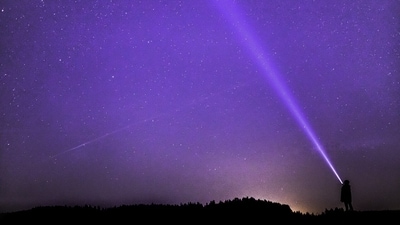
The complex physical processes above their poles generate a radio beam, much like a torch beam, which rotates with the star. With every rotation of the star, this beam looks towards our radio telescope on Earth, which registers a radio flash. With masses equalling our Sun squashed to a space one lakh times smaller, these stars, made almost entirely of neutrons, rotate with a regularity that puts to shame some of the best clocks on Earth. It so happens that measuring the variations in the frequency of these celestial clocks provided a good way to check the ripples due to gravitational wave background.
According to Einstein’s relativity theories, space and time together define the four-dimensional geometry for the events in the Universe. These ripples stretch and squeeze the space-time near the Earth. This makes the radio pulses arrive a little earlier or a little later at our radio telescopes. Astronomers count the number of pulses arriving at the telescope, which is a technique called pulsar timing, to better than a millionth of the pulse period. The variations in observed pulse count every second enable them to measure these tiny stretches and squeezes to one part in a quadrillion (1 with 15 zeros after it). Thus, the radio pulsars act like a stethoscope to sense the vibrational beats produced by the gravitational wave background in the space-time fabric.
The PTA experiments are looking for such vibrations with very low frequencies of nano-Hertz. These frequencies are much lower than the first discovery of gravitational waves in 2015 by the laser interferometer, called LIGO. The waves detected by LIGO were like the high transitory pitch of a Shehnai very different from the continuous lower frequency hum of a Tanpura over a musical concert. The two experiments are looking at different sources and tell us different stories about the observable universe.
The waves that PTAs are sensitive to are likely to cause the pulse counts to vary by a tiny amount over months and years. Measuring this is a challenging enterprise as these experiments need to collect data over decades. Apart from the patience required, the astronomer has to worry about other things which may cause variations on a similar time scale. These “noise sources” are typically much stronger hiding the real gravitational wave signal and need to be understood, measured and separated.
One such “noise” is small delays caused by a very small number of freely moving electrons in the space between us and the pulsars, which reduce the speed of light by a different amount at different frequencies, much like a prism producing the rainbow of colours.
These dispersion delays vary over months as the earth revolves around our Sun and the pulsar as well as “electron clouds” in the intervening space move across our galaxy. It so happens that radio telescopes can measure these delays with much higher precision at operating radio frequencies between 300 to 1000 MHz. The recently upgraded GMRT is the world’s most powerful telescope in this window and this allowed Indian and Japanese astronomers of the InPTA collaboration to measure these delays with unprecedented accuracy, with dispersion accounted for up to the sixth decimal place.
The InPTA astronomers, consisting of young and talented students and researchers, worked hard with their counterparts in European Pulsar Timing Array (EPTA) for more than two years to combine and jointly analyse these data. This improved significantly their ability to sense the gravitational waves they were looking for. In the papers published on June 29, this team has provided the closest evidence so far for the existence of low-frequency gravitational waves, opening a new window to the universe.
Going forward, these data will be combined by all the major pulsar timing array experiments, which include the EPTA and the InPTA along with the North American nano Hertz Gravitational Wave Observatory (NANOGrav) and Parkes Pulsar Timing Array (PPTA), under the auspices of the International Pulsar Timing Array (IPTA) to not only obtain a higher significance of the emerging gravitational wave signal, but also look back in time to understand how galaxies merged and evolved in the history of the Universe.
The stronger signal expected in the data will allow separating the different “tones” in this “cosmic symphony” to identify each “dancer” or black hole pair, whose sound will rise above the background. It will also bring sharper focus to the different “notes” of the background to understand if these are indeed produced by monster black home pairs or some exotic physics such as dark matter or cosmic strings. So, the show has just begun and watch out for more exciting episodes to come.
The author is the Department of Atomic Energy Raja Ramanna Fellow hosted by the National Centre for Radio Astrophysics (TIFR), founder and former Chair of the InPTA collaboration as well as the immediate past Chair of the International Pulsar Timing Array consortium.