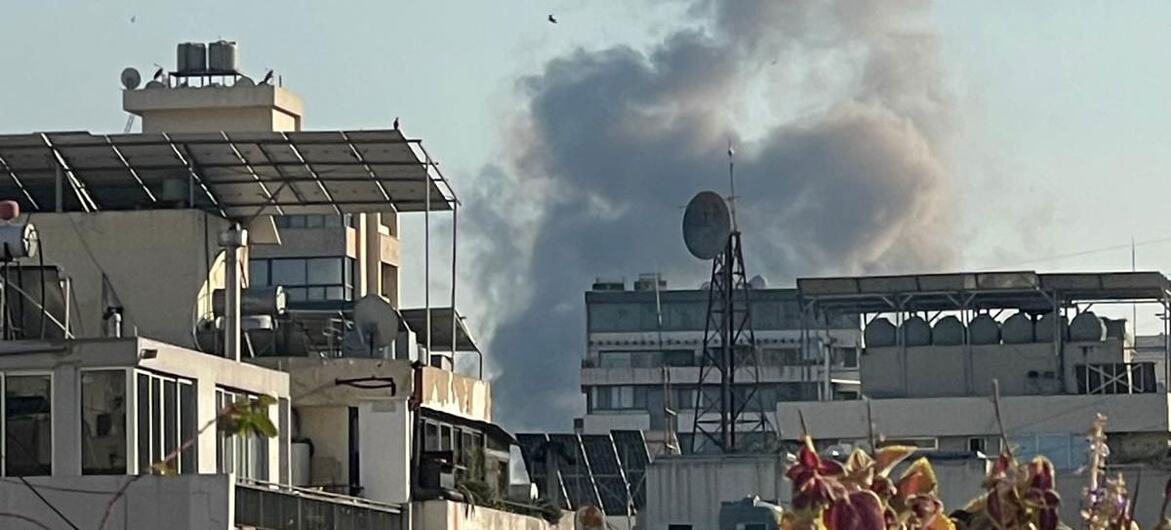
Less than 48 hours after the Kerch Bridge connecting Crimea with Russia proper was damaged by a powerful blast, Vladimir Putin retaliated against Ukraine. Russia fired close to 100 missiles at a variety of Ukrainian cities on October 10 and 11. The rockets hit an array of buildings, including residences and schools, killing at least 19 civilians and injuring more than 100.
On October 17, Russia launched new strikes on Kyiv, the Ukrainian capital, with “kamikaze drones” — low-flying drones that swoop toward their target from the sky and blow up on impact. Early reports said that at least three people were killed and some 18 were wounded in the drone attack.
While the attacks from the past week knocked out power and water to Ukraine’s largest cities, the military value of the attacks was dubious at best. Civilian infrastructure has been the main target. Ukraine’s population seems ever more determined to resist Russia. Experts pointed out that Russia retains a scarce number of precision-guided missiles, and it seemed like a waste to use them on these kinds of targets. Looking ahead, the attacks may well have also created a permission structure for NATO to arm Ukraine with better air defenses. Oh, and there is also the whole “blatantly violating the laws of war” thing. Even India and China are trying to generate some separation from Russia.
So Russia’s missile attacks may have violated international law, alienated longstanding partners, hardened the determination of Ukraine and its allies, and expended scarce munitions without altering the situation on the battlefield. Why did Russia do it?
Trying to explain current Russian foreign policy behavior is complicated, because rational-actor stories have not proven to be a great guide to analyzing 2022. Many experts and policymakers predicted that Russia would not attack Ukraine because it would prove to be such a costly and risky action to take. Indeed, Putin’s initial decision to invade Ukraine seems like an example of what not to do in international relations. The fact that he did it, however, means we need alternative explanations for Russian behavior.
With constant — often flawed — comparisons now being made to the Cuban missile crisis, perhaps it is time to approach this question as Graham Allison, a longtime political scientist and sometime US government advisor now at Harvard’s Kennedy School of Government, did when he wrote Essence of Decision. That 1971 book provided a Rashomon-style explanation of the crisis, using bureaucratic and organizational approaches as well as the rational actor model — the idea that countries can be simplified down to unitary strategic actors pursuing the national interest — to explain US and Soviet behavior.
Consider the following an attempt to explain why Russia took this step from three different levels of analysis: the international, the domestic, and the psychological.
The international level
The perception of Russian power has been on the wane ever since Moscow failed to execute its initial invasion plan of capturing Kyiv in the first week.
Eight months into the war, Ukraine is now on the offensive. Their forces seem better armed, better trained, and better motivated, and most military analysts are predicting further Ukrainian territorial gains before the onset of winter. Russia’s partial mobilization looks like a logistical mess. Only four countries voted with Russia in the latest United Nations General Assembly vote condemning its attempted annexation of Ukrainian territory.
An underrated source of power in world politics is a reputation for effectively wielding power. This means Russia is in serious trouble.
What was supposed to be a lightning-fast decapitation of the Zelenskyy government has turned into a costly conflict with an opponent out-fighting and out-thinking Russians on the battlefield. Even before the recent strikes on civilians, Putin was forced to acknowledge that key partners like China and India had started making noises indicating dissatisfaction with the war.
With Russia distracted by its Ukraine quagmire, countries like Azerbaijan appear to be taking the opportunity to advance their interests against Russian allies. Even states more dependent on Russia are starting to show some independence. Kazakhstan has flatly rejected the legality of referenda annexing Ukrainian territory, while Kyrgyzstan canceled at the last minute Russian-led military exercises to be held on its soil. The attack on the Kerch Bridge was simply the latest symbolic blow to Russian power.
Given this context, it is easy to see why Russia felt the need to escalate the use of violence in the most vicious way possible. Russia very much wants to remind friends and foes alike that it still can project destructive power. And while bombing civilians seems to have minimal military value, Russia might believe it to be an effective signal that bolsters its nuclear threats. After all, the logic runs, if Russia demonstrates that it is unconcerned about the norms and laws governing the use of conventional force, that sends a message that it is likewise unconcerned about the norms and laws governing the use of nuclear weapons.
And the more credible Russia’s nuclear threat is, the more it can rely on that tool as a form of coercive bargaining.
The domestic level
Contrary to popular belief, Putin is not running a one-man regime. Even autocrats need to placate supporters among what political scientists call the “selectorate” — the people or group who, in practice, select a state’s leader. In a democracy, the electorate is the selectorate; in a more authoritarian regime, the selectorate is smaller and murkier. Regardless of regime type, a ruler needs to command a winning coalition with the selectorate.
Who are the actors in Putin’s coalition? A recent Institute for the Study of War (ISW) analysis of Russia’s information space concluded that there were three key pillars of support for Putin: “Russian milbloggers and war correspondents, former Russian or proxy officers and veterans, and some of the Russian siloviki — people with meaningful power bases and forces of their own. Putin needs to retain the support of all three of these factions.”
The reverses on the battlefield in the east and south of Ukraine cost Putin some support among his selectorate. According to the Washington Post, “A member of Vladimir Putin’s inner circle has voiced disagreement directly to the Russian president in recent weeks over his handling of the war in Ukraine.” Kremlin spokesperson Dmitry Peskov told the Post that was “absolutely not true,” even while acknowledging, “There is disagreement over such moments. Some think we should act differently. But this is all part of the usual working process.”
This jibes with the recent public criticisms by Chechen leader Ramzan Kadyrov and Evgeny Prigozhin, head of the Wagner Group, a Russian paramilitary organization, about the way the war has been prosecuted. ISW reported similar discontent from nationalists and military bloggers.
As ISW writes, this dissension has a feedback effect that erodes Putin’s standing: “Word of fractures within Putin’s inner circle have reached the hyper-patriotic and nationalist milblogger crowd, however, undermining the impression of strength and control that Putin has sought to portray throughout his reign.”
Striking Ukrainian civilians with missiles makes sense for Putin within this domestic context. After the bridge attack, there were calls from Russian nationalists to escalate the conflict. They want the gloves to come off in the fight against Ukraine, advocating for ever more brutality. The rocket attacks against Ukrainian cities will placate Putin’s nationalist supporters for the time being, and allows his subordinates and surrogates to make the case on television that they are responding to reverses on the battlefield. Putin’s promotion this week of Gen. Sergei Surovikin, known as “General Armageddon” for his brutality in Syria, will also bolster his standing with nationalists.
The psychological level
While Putin might not be a dictator without constraints, he is far and away the most powerful decision-maker in Russia. US intelligence suggests that he is even giving orders directly to commanders in the theater of operations. Understanding how Putin thinks would go a long way toward explaining his recent actions in Ukraine.
Daniel Kahneman won a Nobel Prize for his research with Amos Tversky demonstrating that most humans do not make decisions based on rational choice, but rather use a collection of cognitive shortcuts known as prospect theory. A central tenet of prospect theory is that individuals will be risk-averse when they are winning, and risk-tolerant when they are losing. In other words, when someone faces a setback relative to the prior status quo, they are more willing to take risks in an effort to “gamble for resurrection.”
This seems to describe Putin’s behavior over the past few months. During the late spring and summer, as Russia was making incremental gains on the battlefield, Putin was content to use a combination of Wagner Group mercenaries and raw recruits from Donetsk and Luhansk, the Russian-held eastern regions of Ukraine, to replenish Russian forces.
After Ukraine started making advances in the east and south, however, Putin finally opted for riskier political actions. He announced a partial mobilization, formally announced the annexation of four Ukrainian regions, and amped up his nuclear threats. This did nothing to stop Ukrainian forces on the ground; in the days after annexation, Russia lost the key logistical city of Lyman, in Donetsk, and then suffered the attack on the Kerch Bridge. In this context, the attacks on Ukrainian cities earlier this month can be viewed as Putin’s attempt to gamble for resurrection.
Prospect theory applies to all individuals; what about Putin’s individual psychology? According to Michael Kofman, an analyst of the Russian military at CNA, a research and analysis organization, Putin is a “master procrastinator.” He delays making big decisions until the last minute, so often paints himself into corners. Or, as Kofman told Puck’s Julia Ioffe last month, “he procrastinates and procrastinates till the options go from bad to worse.”
In all likelihood, Putin did not want to expend scarce ammunition bombarding Ukrainian cities. Faced with a deteriorating military and political situation, however, Putin probably felt as though he had little choice but to lash out.
Where the war might lead
What can we infer from these three different stories?
Weirdly, they suggest that the West should hope Russia’s actions are explained by Putin’s individual psychology. Both the international and domestic explanations suggest that Putin will double down on aggressive actions. At the global level, Russia keeps getting humiliated by UN General Assembly votes. At the domestic level, Putin will need to amp up the barbarism to maintain nationalist support as Russian fortunes in Ukraine continue to deteriorate.
Only Putin’s reputed procrastinating tendencies suggest a return to Russian lethargy in adapting to Ukrainian military successes. It would be ironic indeed if the greatest gift Russia can give Ukraine is Vladimir Putin’s torpor.
Daniel W. Drezner is professor of international politics and co-director of the Russia and Eurasia program at the Fletcher School of Law and Diplomacy at Tufts University.
Update, October 17, 11 am: This story was originally published on October 15 and has been updated to include news of the latest strikes on Kyiv.