Updated on February 1st, 2023 by Aristofanis Papadatos
Every year, we individually review each of the 68 Dividend Aristocrats. The Dividend Aristocrat we’ll be discussing here is Cincinnati Financial (CINF).
Cincinnati Financial has grown its dividend for an amazing 62 years in a row and hence it has one of the longest dividend growth streaks in the stock market.
It is on the Dividend Aristocrats list, a group of stocks in the S&P 500 Index with 25+ consecutive years of dividend increases.
You can see our full list of all 68 Dividend Aristocrats, along with important metrics like dividend yields and P/E ratios, by clicking on the link below:

Not only that, but Cincinnati Financial is also a member of the Dividend Kings, an even more exclusive group than the Dividend Aristocrats. Dividend Kings have grown their dividends for 50+ consecutive years.
There are just 49 Dividend Kings.
Cincinnati Financial’s dividend track record is legendary. And yet, the stock does not appear to be an attractive buy right now. The reason is that its valuation has remained elevated in the past few years, which has simultaneously reduced its dividend yield.
As a result, value and income investors should wait for a meaningful pullback before buying shares. The stock has pulled back a little from its 2022 all-time high but it still appears to be overvalued.
Business Overview
Cincinnati Financial is an insurance company, founded in 1950. It offers business, home, and auto insurance, as well as financial products including life insurance, annuities, and property and casualty insurance. Revenue is derived from five sources, with agencies across 46 states.
The company has more than 1,900 agency relationships with 2,786 locations. Many of them have a meaningful market share as well, as Cincinnati Financial has grown over the years.

Source: Investor Handout
The company has a profitable business model. Instead of focusing solely on high-margin products, Cincinnati Financial is willing to write lower-margin policies. It earns a high level of profit by issuing high volumes and taking market share.
For instance, its home state of Ohio provides a 4.5% market share in its product lines. Insurance is a highly-fragmented industry and hence market share can be difficult to attain.
As an insurance company, Cincinnati Financial makes money in two ways. It earns income from premiums on policies written, and also by investing its float, the large sum of premium income not paid out in claims.
Indeed, $8.4 billion of the company’s cash is invested in common stocks as a way to grow book value over time, with no single stock making up more than 5% of the investment portfolio.
To that end, Cincinnati Financial’s book value is more sensitive to stock market performance than some of its peers, which invest their float exclusively on bonds.
Still, the favorable combination of premiums and investment gains has led to steady growth over many years, and there should be room for continued growth in the upcoming years.
Growth Prospects
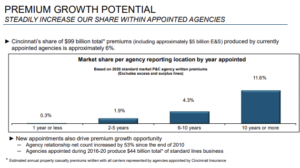
Cincinnati Financial has a positive growth outlook moving forward from new policies written, as well as its equity exposure in the US.
The company has a successful history of growing profits through new policies written, outperforming the industry benchmark, and taking market share as a result.
Source: Investor Handout
Price increases helped the company grow premium revenue for the past several years.
Interest rates remained near record-low levels between 2008 and 2021, thus providing a strong headwind to the investment income of Cincinnati Financial. On the other hand, depressed interest rates provided fuel to an impressive rally of stocks and bonds throughout that period, thus boosting the book value of the insurer.
Due to the unprecedented fiscal stimulus packages offered by the government in response to the pandemic and the war in Ukraine, inflation surged to a 40-year high last year and has remained excessive this year. As a result, the Fed is in the process of raising interest rates aggressively in order to cool the economy.
High interest rates have caused a bear market in stocks and bonds and thus they have significantly reduced the value of the investment portfolio of Cincinnati Financial. The company is expected to report earnings per share of $4.30 for 2022, a 33% decrease compared to 2021.
However, as the Fed has clearly prioritized restoring inflation to its long-term target around 2%, it is likely to achieve its goal sooner or later. Inflation has already begun to moderate, as it has subsided every single month since it peaked last summer. Whenever inflation returns to its normal range, bonds and stocks are likely to retrieve their losses and thus they will significantly increase the value of the investment portfolio of Cincinnati Financial.
It is also important to note that the company will greatly benefit as long as interest rates remain high, as it will invest its insurance premiums at much higher yields than it did in previous years. To cut a long story short, high interest rates have taken their toll on the book value and earnings of Cincinnati Financial but the insurer will almost certainly retrieve these losses in the upcoming years.
We expect Cincinnati Financial to grow its earnings per share by 6% per year on average over the next five years thanks to growth of its insurance business as well as a recovery of the stocks and bonds that are included in its investment portfolio.
Competitive Advantages & Recession Performance
There aren’t many identifiable competitive advantages in the insurance industry, other than brand recognition.
There are generally low barriers to entry in insurance, which leads to fierce competition, as differentiation is very difficult. The good news for Cincinnati Financial is that it thrives on price competition. Cincinnati Financial has decades of experience and has built a close relationship with its customers.
That said, insurance companies are not immune to economic downturns. Cincinnati Financial does not have a recession-resistant business model. In fact, it is more sensitive to recessions than other insurers due to the relatively high exposure of its investment portfolio to the stock market. Earnings-per-share during the Great Recession are below:
- 2007 earnings-per-share of $3.54
- 2008 earnings-per-share of $2.10 (41% decline)
- 2009 earnings-per-share of $1.32 (37% decline)
- 2010 earnings-per-share of $1.68 (27% increase)
Earnings declined significantly from 2008-2010. Insurers like Cincinnati Financial typically sell fewer policies during recessions, along with poor performance of their investment portfolios when markets decline.
That said, the company did remain profitable during the recession, which allowed it to continue raising its dividend every year. And, the company enjoyed a strong recovery in 2010 and thereafter, once the recession ended.
Valuation & Expected Returns
Based on expected earnings-per-share of $4.30 in 2022, Cincinnati Financial stock trades for a price-to-earnings ratio of 26.3. We see fair value at 20 times earnings, meaning it appears that shares are overvalued at this point.
If the shares revert to our fair value P/E ratio, future returns would be reduced by 5.3% per year over the next five years. We see fair value at $86 per share today, which compares very unfavorably to the current share price of $113.
Earnings growth and dividends will help offset the decline. However, the company has fairly modest growth expectations.
We forecast 6% annual earnings growth for Cincinnati Financial. In addition, the stock has a current dividend yield of 2.7%, which is above that of the S&P 500.
Cincinnati Financial’s dividend is secure. The payout ratio currently stands at 70%, which is elevated but should revert to healthy levels in the upcoming years thanks to the expected recovery of Cincinnati Financial.
Given 6.0% growth of earnings per share, a 2.7% dividend and a -5.3% annualized valuation headwind, the stock is expected to offer total returns of only 3.2% per year over the next five years. Therefore, investors should wait for a meaningful correction of the stock before purchasing it.
Final Thoughts
Cincinnati Financial is a high-quality dividend stock that has delivered compelling results for shareholders in the past. The company is not a high-growth name, though, and we believe that earnings will rise at a meager mid-single-digit pace.
Cincinnati Financial is trading at a rich valuation level compared to what seems justified based on its growth outlook and historical valuation.
As a result, the shares earn a hold recommendation at the current valuation level.
If you are interested in finding high-quality dividend growth stocks suitable for long-term investment, the following Sure Dividend databases will be useful:
The major domestic stock market indices are another solid resource for finding investment ideas. Sure Dividend compiles the following stock market databases and updates them monthly:
Thanks for reading this article. Please send any feedback, corrections, or questions to [email protected].