
A Florida Judge Says $165,000 in Fines for 3 Minor Code Violations Is Not ‘Excessive’
April 10, 2024 | Tags: REASON
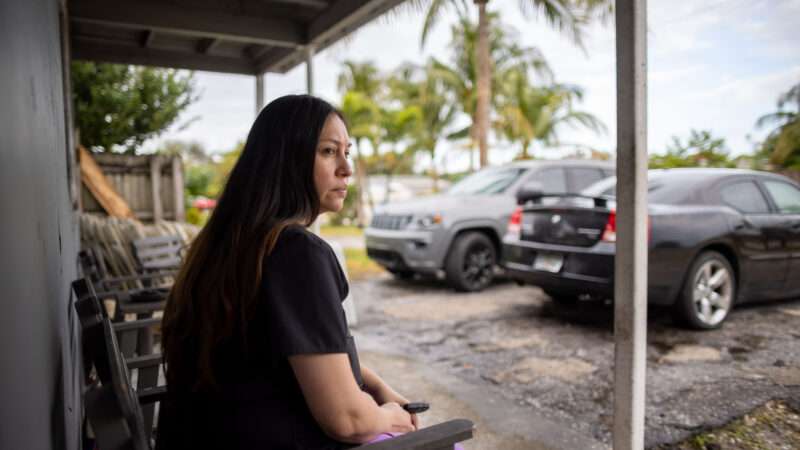
A Florida judge yesterday ruled against a Lantana homeowner who faces more than $165,000 in fines for three minor code violations that harmed no one. Sandy Martinez, who is represented by the Institute for Justice (I.J.), argued that the financially crippling demand, which stems from driveway cracks, a storm-damaged fence, and cars that were parked partially on her own lawn, violates the Florida Constitution’s ban on excessive fines and its guarantee of due process. But Palm Beach County Circuit Court Judge Luis Delgado granted the city’s motion for summary judgment, concluding that the fines were not “grossly disproportionate.”
Martinez hopes to persuade Florida’s Fourth District Court of Appeal that Delgado is wrong about that. “Six-figure fines for parking on your own property are outrageous,” says I.J. attorney Mike Greenberg. “The Florida Constitution’s Excessive Fines Clause was designed to stop precisely this sort of abuse—to prevent people from being fined into poverty for trivial violations. The court’s opinion renders those bedrock protections a dead letter. We will appeal.”
Martinez’s debt to the city began accumulating in 2013, when she was cited for cracks in her driveway. For a single mother with a modest income who was living from one paycheck to another, the cost of laying a new driveway was hard to manage. But in the meantime, daily fines of $75 continued to accrue, eventually reaching a total of $16,125 with interest—”far greater than the cost of an entirely new driveway,” she notes in the lawsuit that she filed against the city in February 2021.
In 2015, Martinez was cited for a fence that had been knocked down by a storm. Again, the repairs necessary to bring her into compliance were more expensive than she could immediately afford. While she waited for her insurance company to pay her claim for the fence, daily fines of $125 accumulated, eventually hitting a total of $47,375 with interest—”several times the cost of the repair and substantially more than the cost of a completely new fence,” according to her complaint.
Finally, Martinez was cited in 2019 for improperly parking cars on her own property. At the time, she was living with her three children, her mother, and her sister. Martinez, her two adult children, and her sister all had cars that they used to travel from home to work and back. Her street has no curbs and is not wide enough to accommodate parked cars. Since Martinez and her relatives could not legally and safely park on the street, the driveway seemed like the only viable option. When all four cars were parked at Martinez’s home, two of them sometimes extended slightly beyond the driveway, which is flanked by her lawn and a walkway.
As Martinez’s complaint notes, “parking on one’s own front yard space, even a tiny bit, is illegal in Lantana.” The penalty is $250 per day and fines continue to accrue until a city inspector verifies that the violation has been corrected. Although Martinez says she promptly fixed the parking issue by making sure no car was touching her grass and left a voicemail message with the code enforcement office requesting a compliance check, no inspector came by. Unbeknownst to her, the fines continued to accumulate for more than a year.
By the time the city deigned to recognize that the parking problem had been corrected, Martinez’s complaint says, the total bill was $101,750, “nearly four times her annual income.” Martinez understandably thinks “it’s ridiculous that Lantana would charge me over $100,000 for parking on my own grass that I paid for.”
The city’s concern about cars parked on grass seems to be strangely selective. City officials suggested that Martinez could resolve the issue by parking one or more cars on the grassy area between the sidewalk and the street. She rejected that option because she lives at the intersection of two busy streets where car accidents are common. “Just a month or two after the case was filed,” Greenberg says, “there was a three-car crash” at that intersection, and photos showed that “if a car had been parked where the city suggested that she park, it would have been severely damaged.” But as far as the city was concerned, parking entirely on publicly owned grass was perfectly fine, while parking on your own lawn, even slightly, was intolerable.
Greenberg notes another counterintuitive distinction that the city draws between parking on public vs. private property. If you illegally park a car on the street, that violation triggers a one-time fine; the city cannot fine you again unless it verifies that you have failed to move the car. But if you illegally park a car on your own property, Greenberg says, “they just assume that that violation continues indefinitely until an inspector comes out and confirms that it’s not ongoing anymore.” And meanwhile, the daily fines pile up.
That approach, I.J. argues, violates the right to due process. In effect, Greenberg says, the city is “treating each day as its own independent offense” without “proof that the offense actually happened.”
In view of Martinez’s financial circumstances, the city eventually offered to let her settle her bill by paying $25,000. But at the time, Greenberg says, that was “over half of her annual income,” and “that offer was only good for about three months.” Because “she didn’t come up with that $25,000 in three months,” he says, the city again demanded the full amount of $165,250.
Those fines are not excessive, Delgado ultimately concludes in his 10-page order. But before he addresses that question, he faults Martinez for failing to attend code enforcement hearings. Greenberg notes that the hearings were scheduled “on weeknights at about 5:30 p.m.,” which made them difficult for Martinez to attend given her work and parenting responsibilities. In any case, he says, the only point of the hearings was to determine whether the violations had occurred, which Martinez did not contest.
There were indisputably cracks in Martinez’s driveway, her fence definitely was knocked down by a storm, and she admitted that car tires had impermissibly touched her grass. Her argument was that the resulting penalties were incommensurate with those violations.
If that is what Martinez thought, Delgado says, she should have challenged the fines in the circuit court within 30 days of “the final decision’s execution,” as required by law. Greenberg says holding Martinez to that deadline “doesn’t make sense when the fines are continuing to run and we don’t know what the final amount is going to be.” For the driveway and fence violations, the fines kept accumulating “until she [could] save up the money to fix the problem.” And Martinez says she thought she had taken care of the parking violation until she discovered, more than a year later, that no one from the city had verified her compliance. By then, the initially modest bill had ballooned into six figures.
Delgado was unfazed by those complications. Because Martinez missed the 30-day window, he says, she gave up her right to argue that the city’s code enforcement is unconstitutional as applied to her, which would amount to “a collateral attack upon an order concerning matters that could have been properly raised on appeal.” As Delgado sees it, that means Martinez can only argue that Lantana’s code enforcement system is unconstitutional on its face, meaning “no set of circumstances exist” in which application of the ordinance would be constitutional. The significance of that distinction is unclear, however, because Delgado does eventually seem to consider whether Lantana’s system of fines is unconstitutional as applied to Martinez.
“Fines are excessive when they shock the conscience and are unreasonably harsh or oppressive penalties in proportion to the violations to be redressed,” Delgado writes, but “substantial deference should be given to the legislature’s determination of an appropriate fine.” The fines imposed on Martinez, he says, “were well within the range deemed appropriate.”
Even considering the accumulation of fines and interest, Delgado says, the sum that Martinez owes is “not grossly disproportionate to her offense.” He argues that “the fines are proportionate to the harm caused in the sense that the violations have been enduring for a number of years.” In other words, Delgado thinks it is reasonable to penalize Martinez for her inability to make repairs she could not immediately afford and for her mistake in thinking that the parking violation had been resolved.
Delgado mentions Martinez’s claim that Lantana’s ordinance “violates due process because it establishes limitless fines that led to the specific fines at issue.” But he does not address the argument that Lantana imposes those “limitless fines” by presuming ongoing code violations without proof of them.
Having addressed Martinez’s specific claims of hardship and disproportionality after saying it was too late for her to raise them, Delgado applies the stricter requirements for a facial challenge. “Though the fines imposed are admittedly high, the code and statute itself are not inherently arbitrary, discriminatory, or oppressive,” he says, and Martinez “has failed to establish that there is no set of circumstances in which the acts would be valid.”
Greenberg thinks Delgado’s deference to legislative wisdom is misplaced in the context of a constitutional challenge like this one. If the legislature’s determination of appropriate fines is the only test, he wonders, “why have constitutional protections in the first place?” The whole point of those guarantees, he notes, is to “protect us from legislative encroachments.”
Fines like these “are not just abusive,” I.J. attorney Ari Bargil says. “They are also unconstitutional. We look forward to continuing this battle on Sandy’s behalf to ensure that all Floridians can be free from astronomical fines like those imposed by Lantana in this case.”
The post A Florida Judge Says $165,000 in Fines for 3 Minor Code Violations Is Not ‘Excessive’ appeared first on Reason.com.
Read More…